
What Claire taught me
I was working with the senior leadership team of a medium sized organisation when I noticed something interesting about one of the leaders. I'll call her Claire.
Claire was carrying a significant volume of work and was clearly operating close to capacity. Like her colleagues, she had access to AI tools that could have taken some of the pressure off.

When capacity is already stretched, even a tool designed to make work easier can feel like another demand. For Claire, AI initially created more information to process rather than less.
The irony was that AI itself had become another source of pressure for her.
Claire had deliberately chosen not to use it. Every time she gave AI a prompt, she felt overwhelmed by the amount of information it produced. Rather than making things easier, it added another layer of cognitive load: more information to process, more decisions to make, and one more thing she felt she needed to understand.
Her colleagues were using AI extensively, but Claire was adamant it wasn't for her. She told me she would much rather work through things at her own pace, understand what she was doing and keep a sense of control than be bombarded with outputs she didn't have the capacity to process.
What changed wasn't the technology. We changed the demand we were placing on her.
Rather than asking AI to think for her, we explored how she could use it simply to remove some of the repetitive, low value administrative tasks from her day.
That felt manageable.
She didn't suddenly become an enthusiastic AI adopter, and she didn't need to. She kept her use of AI deliberately light, using it where it genuinely reduced friction rather than adding another layer of demand.
For me, it was a powerful reminder that the question isn't always "How can we get people to use AI?"
The more important question may be: "Does this person currently have the capacity to use it well?"
Because when human capacity is already depleted, even a tool designed to make life easier can feel like another demand.
But that was not the end of Claire's story.
As her team worked through the Workforce Capacity Programme, something shifted. With more capacity freed up, Claire began to see that her way of working could adapt, just as her beliefs about herself could. The voice that said "AI isn't for me" turned out to be a pattern, not a fact.
She was then paired with an AI specialist to explore how AI could open up space rather than fill it. Not more outputs to process, but room for creative solutions and big picture thinking.
Claire learned new skills. Not because someone pushed a tool at her, but because she now had the capacity to learn, and the belief that she could change and see things differently.
And the difference showed up well beyond her inbox.

When capacity returns, the relationship with technology can change too. With greater resilience, focus and confidence, AI became a tool Claire could use on her terms, creating space for better thinking rather than adding to the pressure.
She stopped taking work home. She stopped thinking about it once the day was done. With that space came a new way of looking at her projects, and something she hadn't felt in a long time: she was beginning to enjoy her job again.
She felt empowered to do her work well. She remembered why she had chosen this path in the first place. The joy came back into her role, and with it came more creative solutions and a real increase in her output.
Her data told the same story. Over four months, her scores on the Perceived Stress Scale and the WHO5 Wellbeing Index improved markedly. Her heart rate variability trended steadily upwards, finishing nearly 45ms higher than where she started. In plain terms, her nervous system had become more resilient, and far better able to meet stress and recover from it.
She was not working harder, now she had the capacity to work better.
That was the power of sessions 2-7 of the 8 session programme. The order matters: capacity first, then beliefs, then skills.
Claire is not an outlier. Most leadership teams I speak with are asking how fast they can roll out AI, unfortunately far fewer are asking what state their people are in when it arrives.
The uncomfortable truth
AI doesn’t make people better, it makes people more of what they already are. If you’re already operating busy or disorganised, it will make you more of the same. A clear, regulated, well rested mind working with AI becomes remarkable. A depleted, overstimulated mind working with AI becomes overwhelmed faster, makes mistakes at greater scale, and burns out sooner.
In March 2026, researchers writing in Harvard Business Review gave this a name: AI brain fry. They defined it as mental fatigue from excessive use or oversight of AI tools "beyond one's cognitive capacity". Read that last phrase again. Not beyond the technology's capacity..beyond ours.
After more than two decades as an Advanced Respiratory Physiotherapist in the NHS, and now in the final stages of PhD research into breathwork and nervous system regulation, I see this through a particular lens. So let me walk through every angle, the hopeful and the sobering, before I tell you where I land.
Angle one: AI as the great liberator
The hopeful case is real, and it is well evidenced.

AI can remove the repetitive tasks that consume our attention, creating valuable space for creativity, connection, judgement and meaningful work. But the time we give back only becomes valuable when people have the capacity to use it well.
When economists Erik Brynjolfsson, Danielle Li and Lindsey Raymond studied 5,179 customer support agents given an AI assistant, productivity (measured as issues resolved per hour) rose by 14% on average, for novice and lower skilled workers it rose by 34%. Customer satisfaction and staff retention improved too.
This is the promise most of us signed up for. Drafting, summarising, scheduling, formatting, chasing. The tasks that drain attention, you hand those over, and you get time back for the work only humans can do: thinking, connecting, creating, caring.
I believe in that promise. But there is an assumption hiding inside it. It assumes the time we free up will be spent on higher value human work. However, that only happens if the human has the capacity to do higher value work.
Freed time is not the same as restored capacity. An empty diary does not refill an empty tank.
Angle two: AI as a thinking partner
The more interesting story is not AI as an assistant. It is AI as a partner, and partnerships only work when both parties bring something.
In one of the most cited studies of the AI era, researchers from Harvard and Boston Consulting Group gave 758 consultants access to GPT-4. On tasks within the AI's capabilities, consultants completed 12.2% more tasks, 25.1% more quickly, with more than 40% higher quality than a control group.
Then came the twist. On a task that sat outside the AI's capabilities, consultants using AI were 19 percentage points less likely to produce a correct answer than those working without it.
The researchers called this the "jagged technological frontier". AI is brilliant at some tasks and quietly wrong at others that look almost identical. Telling the difference is entirely a human job. It requires discernment, scepticism and the confidence to overrule a fluent, persuasive machine.
A 2025 study by Microsoft Research and Carnegie Mellon University, surveying 319 knowledge workers, puts it plainly: "Confidence in AI is associated with reduced critical thinking effort, while self-confidence is associated with increased critical thinking."
So the partnership depends on the human staying sharp enough to lead it. When the human is depleted, partnership quietly becomes deference.
Angle three: when the partner becomes the pressure
Here is what the evidence says is happening on the ground.
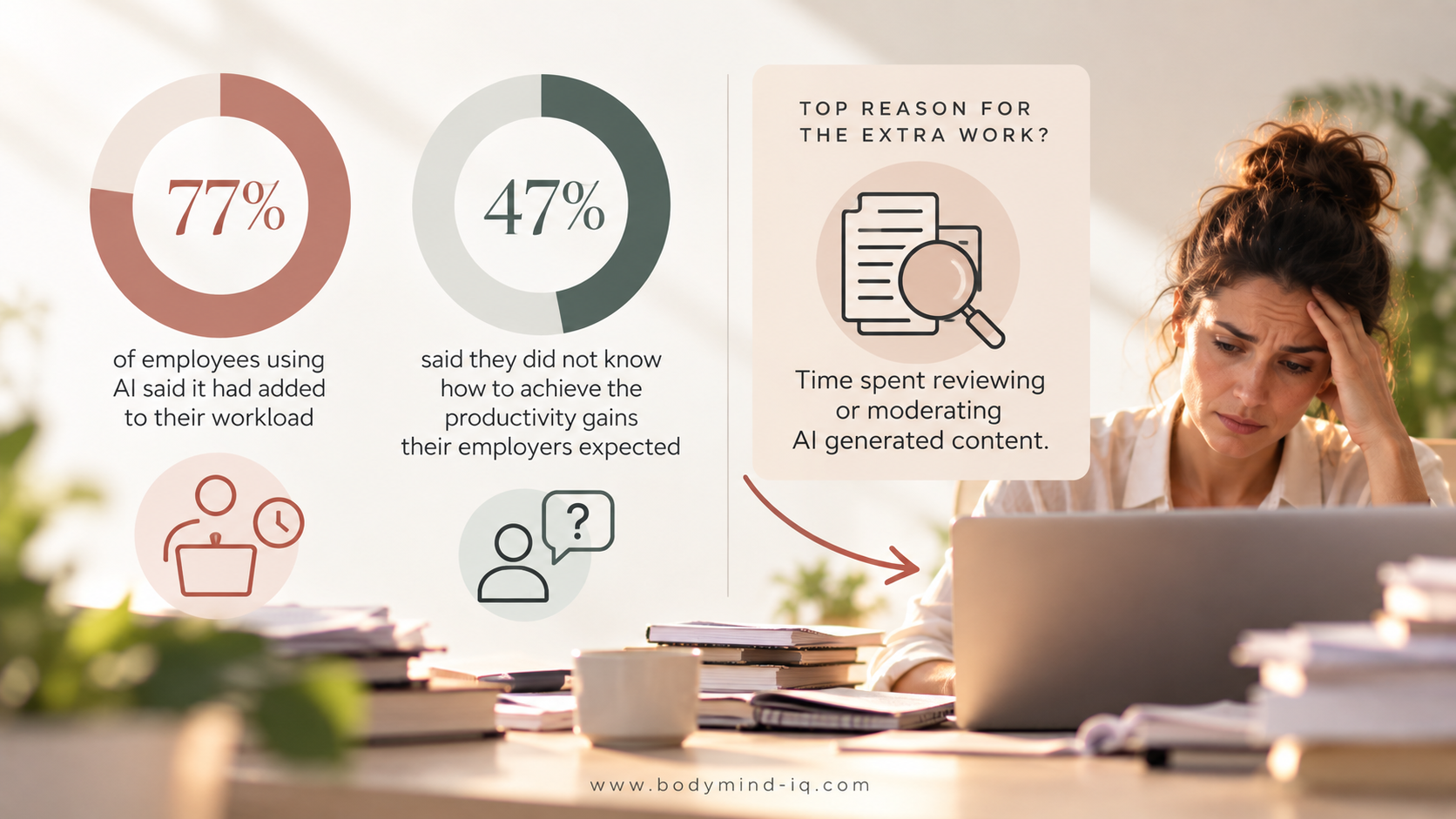
AI can create productivity gains while simultaneously creating new work. For many employees, the time saved generating content can be replaced by the time required to review, moderate and make sense of what AI produces.
In Upwork's 2024 global study, 96% of C suite leaders expected AI to increase productivity. Yet 77% of employees using AI said it had added to their workload, and 47% said they did not know how to achieve the productivity gains their employers expected. The top reason for the extra work? Time spent reviewing or moderating AI generated content.
That pattern has only deepened with Berkeley Haas researchers Aruna Ranganathan and Xingqi Maggie Ye. They followed 200 employees at a US technology company from April to December 2025 and found AI didn’t reduce work, it intensified it, creating "a continual switching of attention, frequent checking of AI outputs, and a growing number of open tasks."
Then there is what Stanford and BetterUp researchers call workslop: AI generated work that looks polished but does not move anything forward. In their survey of 1,004 US desk workers, 40% had received workslop in the past month, and each instance took an average of 1 hour 51 minutes to deal with.
And the brain fry research I opened with, a survey of 1,488 US workers, found that people with high levels of AI oversight reported 14% more mental effort, 12% greater mental fatigue and 19% greater information overload. Productivity rose for those using three or fewer AI tools, and fell for those using four or more. Among workers experiencing brain fry, 34% were actively intending to leave, against 25% of those who were not.
The pattern is clear. AI does not remove cognitive load, it moves it. From doing the work to supervising, checking and deciding. And lets be real, supervision is the most cognitively expensive work there is.
Angle four: what is happening inside the body
This is the angle most AI strategies leave out entirely, and it is the one I care about most.
Every skill AI asks of us (judgement, discernment, verification, the ability to pause and say "that sounds right, but it isn't") lives in the prefrontal cortex. It is the most sophisticated part of the human brain. It is also the most fragile under pressure.
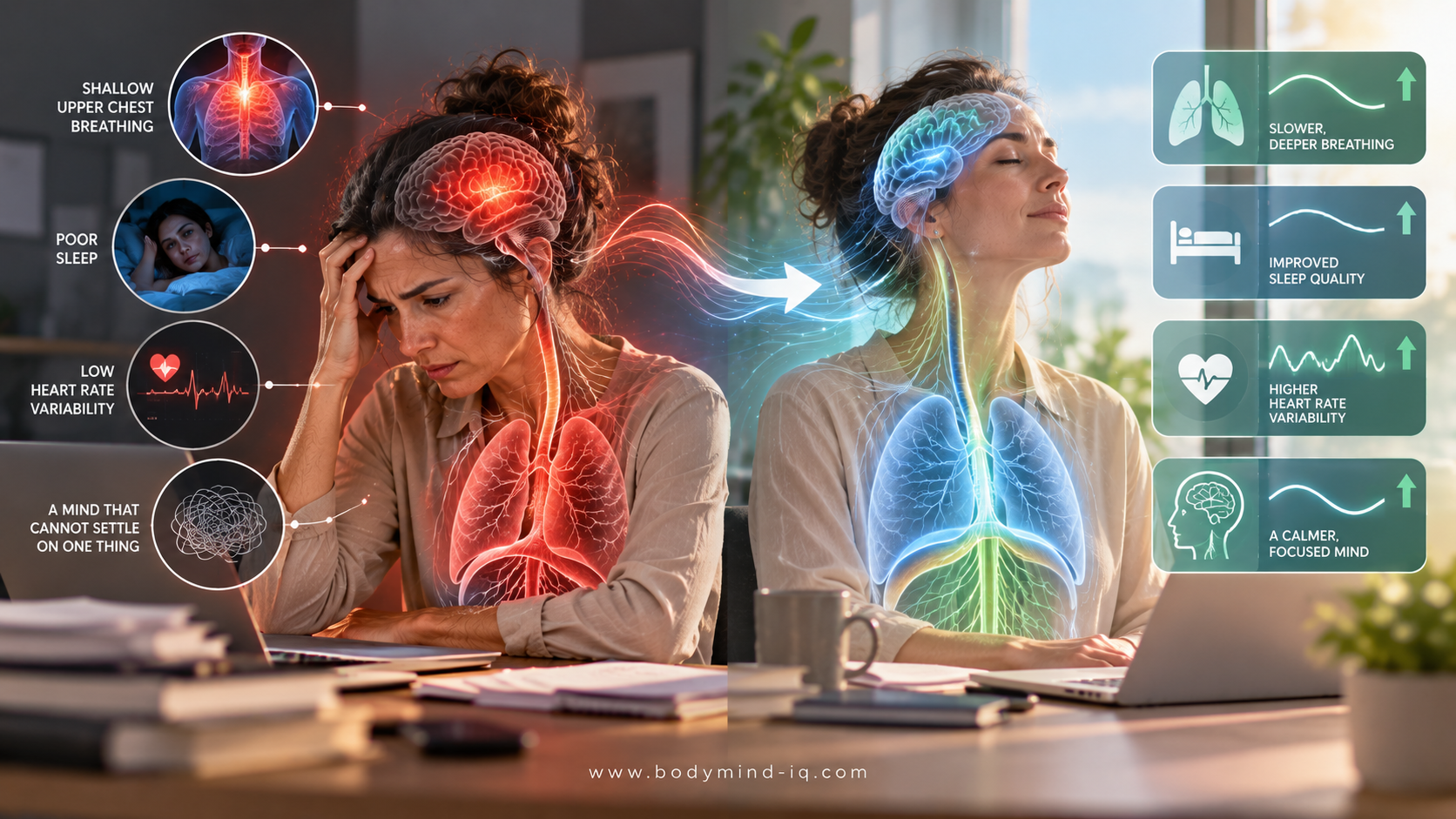
Stress is not simply something we experience psychologically. It is a physiological state involving breathing, heart rate, autonomic regulation, sleep and cognitive function. When the stress response remains switched on, the body carries the cumulative cost.
Neuroscientist Amy Arnsten of Yale summarised decades of research in Nature Reviews Neuroscience: "Even quite mild acute uncontrollable stress can cause a rapid and dramatic loss of prefrontal cognitive abilities." Under stress, control shifts "from slow, thoughtful PFC regulation to the reflexive and rapid emotional responses of the amygdala."
Now look at the environment we are asking people to think in. Microsoft's 2025 Work Trend Index found employees are interrupted every two minutes during core hours, 275 times a day, and 48% say their work feels chaotic and fragmented.
Put those two facts side by side. The skills AI demands are prefrontal skills. The conditions modern work creates switch the prefrontal cortex down. We are handing our most powerful tools to nervous systems stuck in survival mode, then wondering why the results disappoint.
This is what allostatic load looks like in a working day: the cumulative wear of a stress response that rarely switches off. It shows up in shallow, upper chest breathing, poor sleep, low heart rate variability and a mind that can’t settle on one thing. The good news is that the body also offers us a way back through our breath. Slow, regulated breathing is one of the few direct, voluntary levers we have on the autonomic nervous system, and it can be learned, practised and measured.
Angle five: the line missing from the budget
Look at a typical AI transformation budget, the includes licences, integration, data infrastructure, training on the tools, change management amongst others.
Now look for the line that invests in the people who will operate all of it. Not just their skills, but their capacity, because in most organisations, that line does not exist.
We would never buy a fleet of high performance vehicles and forget the drivers that operate them need to be physically able and well rested to operate them. Yet that is broadly what is happening. When Upwork found that 47% of AI users did not know how to achieve expected gains, most commentators called it a skills gap. I would argue a large part of it is a capacity gap, because you cannot learn, adapt and exercise judgement with a nervous system that has nothing left.
The managers being asked to lead this change are under strain themselves. Gallup's State of the Global Workplace 2026 reports global manager engagement fell from 27% to 22% between 2024 and 2025. These are the people we expect to model calm, curious adoption for everyone else.
This is the blind spot: organisations are upgrading the technology and leaving the human operating system on an old, overloaded version.
Angle six: the strongest case against me
A fair argument deserves its best opponent, so here it is.
"This is a transition cost. The tools will improve. Agents will take on the checking. People will adapt, as they did with email and smartphones. And if workers are struggling, that is a training and design problem, not a biological one."
There is truth in this. The brain fry research itself shows that design matters: fewer tools, clearer workflows and AI that removes repetitive work can reduce strain rather than add to it, good design is part of the answer.
But it does not hold up as the whole answer, for three reasons.
Every efficiency gain so far has been reinvested in more output, not more recovery. That is exactly what the Berkeley researchers observed, that when AI made tasks faster, people simply took on more of them.
Better AI raises the stakes of human judgement rather than lowering them. The more capable and fluent the system, the harder its errors are to spot, and the more expensive it is to miss one.
Training lands on whatever brain receives it. A depleted nervous system does not learn, retain or apply new skills well. Skills and capacity are not alternatives, in fact capacity is the soil the skills grow in.
Email and smartphones are not reassuring precedents either. Yes we did adapt to them, but we adapted into the ‘always on’ culture that has us interrupted 275 times a day.
Where I land: capacity is the real bottleneck
Having looked at every angle, my conclusion is simple.
AI is an amplifier, it multiplies whatever human capacity it is given. Give it a regulated, rested, clear thinking person and it becomes a genuine partner. Give it a depleted one and it becomes another source of pressure, operating at the speed of software.
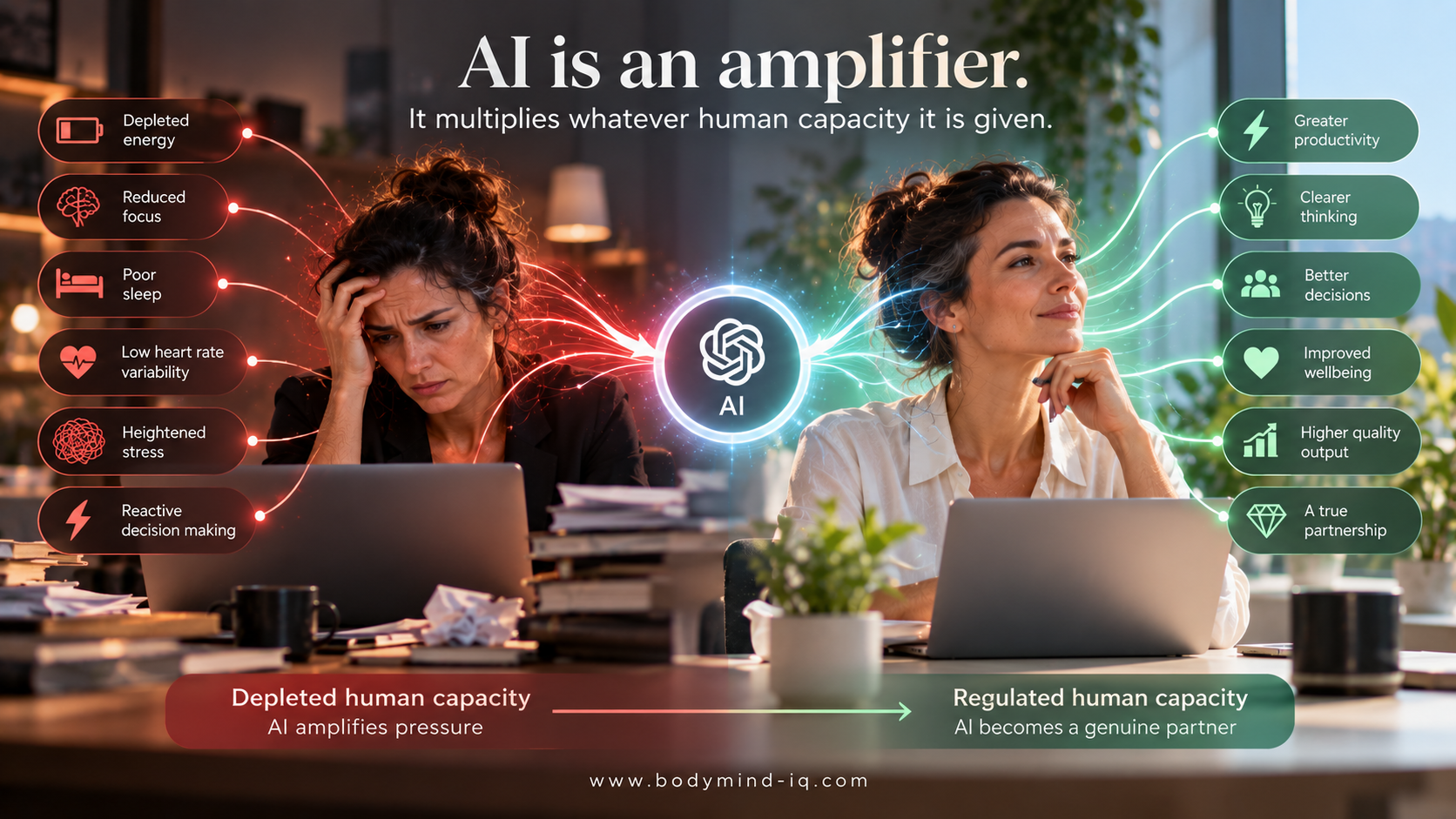
AI does not operate in isolation from the person using it. It amplifies the capacity that is already there, potentially accelerating creativity and productivity when people are regulated and resourced, or amplifying pressure when they are depleted.
The bottleneck of the AI era is not computing power, it’s human capacity. So if you are leading an AI transformation, here is what I would do.
Measure capacity before you measure adoption. Know where your people are losing energy, focus and resilience before you add more to their plate.
Treat regulation as infrastructure, not a perk. Nervous system regulation is a skill that can be taught at work and a regulated team makes better calls with AI.
Interrupt the patterns AI accelerates. Agree clear AI practices: how many tools, when outputs get checked, when people are offline and don’t let speed quietly become intensity.
Protect the foundations. Sleep, movement, nutrition and connection are not lifestyle extras, they are the very hardware that judgement runs on.
Track human metrics alongside AI metrics. Combine how people say they feel with objective markers such as sleep, respiratory rate and heart rate variability. Because if productivity rises while capacity falls, you are borrowing from the future.
The organisations that thrive in the AI era will not be the ones with the most tools, they will be the ones whose people still have the capacity to think.
A final thought
We have spent the last few years asking whether people are ready for AI, I think the better question is whether we are ready to look after the people who will use it.
Claire did not need more AI to begin with, she needed less demand. Once the capacity was there, the skills followed.
If AI transformation is on your agenda and you want to understand where your workforce is losing capacity, that is exactly the work we do at BODY | MIND IQ. I would love to hear what you are seeing in your own organisation.
Sources
Bedard, J. et al. (2026) When Using AI Leads to "Brain Fry", Harvard Business Review, 5 March 2026. See also BCG summary and Fortune coverage
Brynjolfsson, E., Li, D. and Raymond, L. Generative AI at Work, NBER Working Paper 31161
Dell'Acqua, F. et al. (2023) Navigating the Jagged Technological Frontier, Harvard Business School Working Paper
Lee, H. P. et al. (2025) The Impact of Generative AI on Critical Thinking, Microsoft Research and Carnegie Mellon University, reported by The Register
Upwork Research Institute (2024) Upwork Study Finds Employee Workloads Rising Despite Increased C Suite Investment in AI
Ranganathan, A. and Ye, X. M. (2026) AI Doesn't Reduce Work, It Intensifies It, Harvard Business Review, summarised by Simon Willison
BetterUp Labs and Stanford Social Media Lab (2025) The Hidden Costs of Workslop
Arnsten, A. F. T. (2009) Stress signalling pathways that impair prefrontal cortex structure and function, Nature Reviews Neuroscience, 10(6), 410 to 422
Microsoft WorkLab (2025) Breaking Down the Infinite Workday, Work Trend Index
Gallup (2026) State of the Global Workplace