
Unresolved survival patterns keep the nervous system locked in protective loops. Here's the science of why healing starts at the cellular level and how breathwork gets there.
Abstract visualization of nervous system healing pathways
Why willpower fails the nervous system
You've tried everything. The protocols, the supplements, the meditation apps, the therapy. And yet your body is still in survival mode. Your nervous system still sends alarm signals at the slightest perceived threat. Your sleep is still shallow, your energy is still depleted, you still feel that underlying current of fear or overwhelm, even when logically you know you're safe.
This isn't a willpower failure, it's a neurobiology problem.
Here's the issue: the conscious mind is not where most of your behaviour actually gets generated. Decades of research on unconscious processing show that judgment, evaluation and behavioural guidance run largely outside conscious awareness - the conscious mind functions less like a director calling the shots in real time and more like an interpreter making sense of decisions already in motion. When your nervous system has learned, through repeated experience, that the world is threatening, that interpretation is encoded exactly there, in the processing you don't consciously control. It's not a belief you can think your way out of, it's a biological pattern.
Stephen Porges' polyvagal theory explains how this works. The nervous system is constantly engaged in what he calls "neuroception" - an automatic, below conscious process of scanning the environment for cues of safety or danger. This isn't something your conscious mind controls. The vagus nerve, which runs from the brain down through the body, is reading data points continuously: a tone of voice, a memory, a physical sensation, a time of day. Based on this input, the nervous system decides whether to activate (fight/flight) or relax (rest/digest). When the nervous system has been conditioned by years of stress or trauma to interpret the world as unsafe, neuroception stays locked in threat detection mode.You cannot out think a nervous system in threat detection mode. You need a different input, a body based one, a physiological one.
How childhood wires the nervous system for survival
The roots of this pattern usually go back further than you'd expect.
National surveillance data on Adverse Childhood Experiences (ACEs) shows that roughly two thirds of U.S. adults report at least one serious childhood adversity, and about one in six report four or more. These aren't rare and the nervous system's response to them isn't a minor adjustment, it's a complete rewiring of the baseline.
Bessel van der Kolk, trauma researcher, has spent decades documenting how the nervous system encodes experience. Childhood is the critical period because the nervous system is still developing. When a child is exposed to repeated unpredictability, criticism, abandonment, or threat, their nervous system doesn't just react to that event, it imprints a lesson, it learns that the world is unsafe. It learns that relationships are unreliable. It learns that pain might come without warning. And it builds a response system around that learning.
The nervous system doesn't reason about whether that threat still exists, once the pattern is encoded, it runs automatically. An adult who was abandoned by a parent at age six might logically know they have a committed partner now, but their nervous system, which learned "people leave", might still interpret a partner's evening meeting as a threat signal. The nervous system generates anxiety not because the person is irrational, but because the nervous system is doing its job: protecting based on what it learned.
These patterns aren't bugs in the system, they were adaptations. When your environment was genuinely unsafe, a nervous system locked in survival mode kept you alive. The problem is that these patterns don't automatically turn off when the threat ends. The nervous system continues running the same protective program, even decades later, even in an objectively safe environment.
“Trauma interferes with the brain circuits that involve focusing, flexibility, and being able to stay in emotional control. A constant sense of danger and expectation of harm keeps the nervous system stuck in a state of hyper-arousal.”
What dysregulation actually looks like
Most people don't recognise dysregulation as a nervous system problem, instead they experience it as symptoms.
It’s the chronic fatigue that doesn't improve with rest. The difficulty sleeping, or waking unrefreshed even after eight hours. It’s the persistent anxiety or a sense of dread that appears without obvious cause. And even digestive issues (IBS, food sensitivities, poor absorption. Hormone imbalance, irregular cycles, low libido, temperature dysregulation). IT’s also the migraines or chronic pain that moves around the body without a clear structural cause. And the difficulty concentrating, "brain fog," or an inability to make decisions even about small things.
These aren't separate problems, they're symptoms of the same root cause: a nervous system locked in chronic sympathetic activation (the "on" switch of the stress response). When the sympathetic nervous system is chronically overactive, the body deprioritises everything that isn't about immediate survival.
Digestion slows. The immune system becomes dysregulated - the inflammation that should resolve quickly stays elevated. Sex hormones drop because reproduction is a low priority when the body thinks it's in danger. Sleep becomes shallow because part of the nervous system is always on alert. The body can't repair itself effectively because repair happens in the parasympathetic state (the "off" switch) and your nervous system won't switch into that mode.
This is why supplements, protocols, and medications often fail to deliver lasting relief. They're treating the downstream effects of dysregulation, the fatigue, the digestion, the hormone levels, without addressing the nervous system state that's generating the symptoms. It's like bailing water out of a boat while the hole is still open.
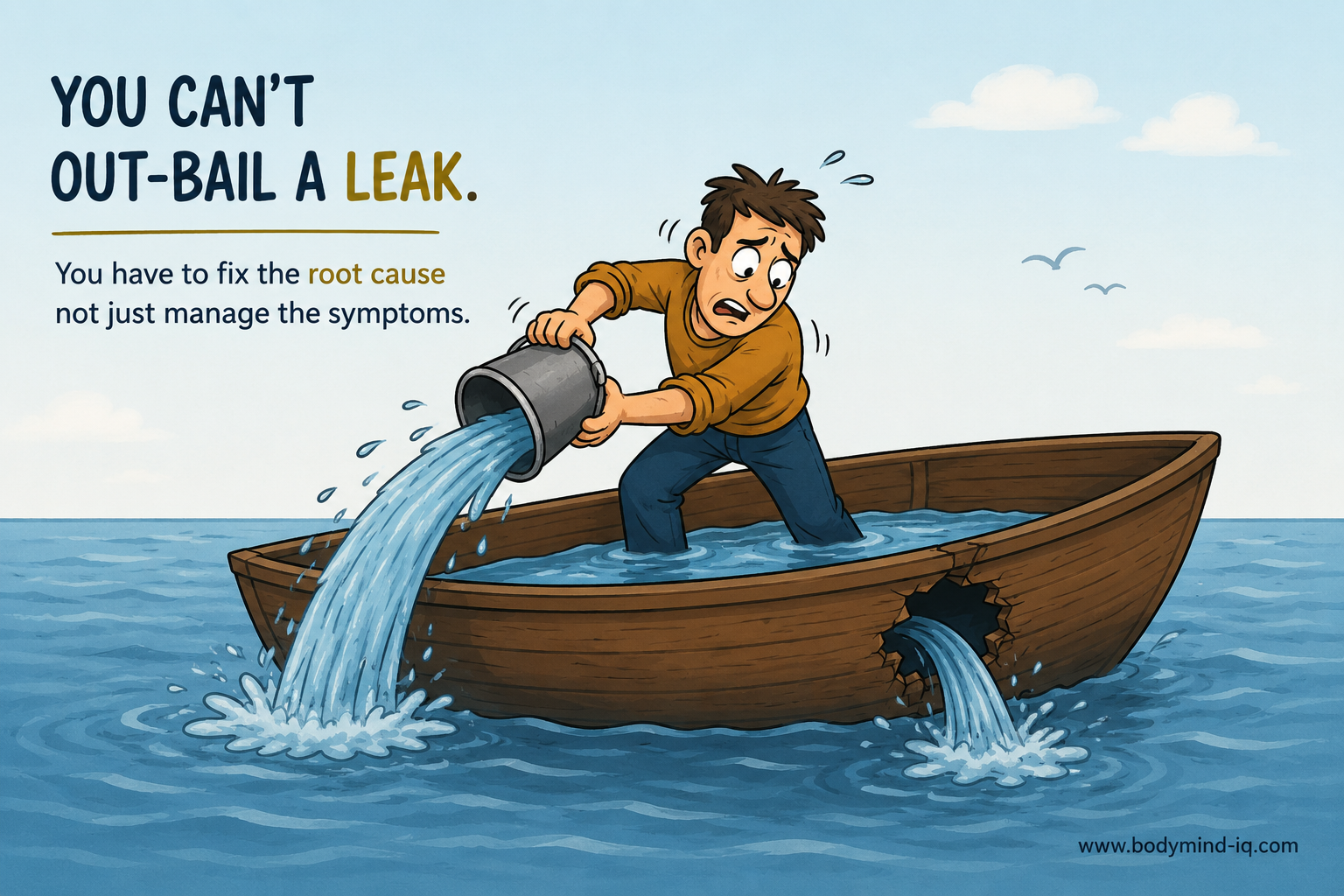
An analogy of fixing symptoms and not addressing the root cause of the problem
What healing at the cellular level actually means
When someone says "your nervous system needs to heal," what does that actually mean?
It means making a measurable change in the physiological markers that distinguish a dysregulated nervous system from a regulated one.
Vagal tone - the baseline strength of your parasympathetic nervous system, is one marker. Vagal tone determines how quickly you can shift from stress activation to calm, and how long you can stay calm. Higher vagal tone correlates with better emotional regulation, sleep quality, digestion, and recovery. You can measure it, because it's not abstract.
Heart Rate Variability (HRV) - the variation in time between heartbeats, is another. In a regulated nervous system, the heart rate isn't metronome steady. It varies based on what's happening. When you breathe in, the heart speeds up slightly; when you breathe out, it slows. This variation is healthy. In a dysregulated nervous system, HRV drops - the nervous system is so locked down that even the heart can't vary its rhythm naturally. As healing happens and the nervous system relaxes and HRV improves.
Inflammatory markers - cytokines like IL-6 - stay elevated when the nervous system is in chronic threat mode. A randomised controlled trial found that a slow-paced breathing technique measurably reduced circulating IL-6 by stimulating the vagus nerve's cholinergic anti-inflammatory pathway, direct evidence that changing the breath can shift the body out of a pro-inflammatory state.
Sleep architecture - not just total sleep, but the quality of sleep cycles, improves as the nervous system recovers. Cortisol patterns normalise and the HPA axis function (the feedback loop between brain and adrenals that manages stress hormone release) settles into a healthy rhythm.
Healing at the cellular level means these markers all shift in the direction of regulation. It's not "feeling better" although that happens too. It's that the body's physiology has genuinely changed.
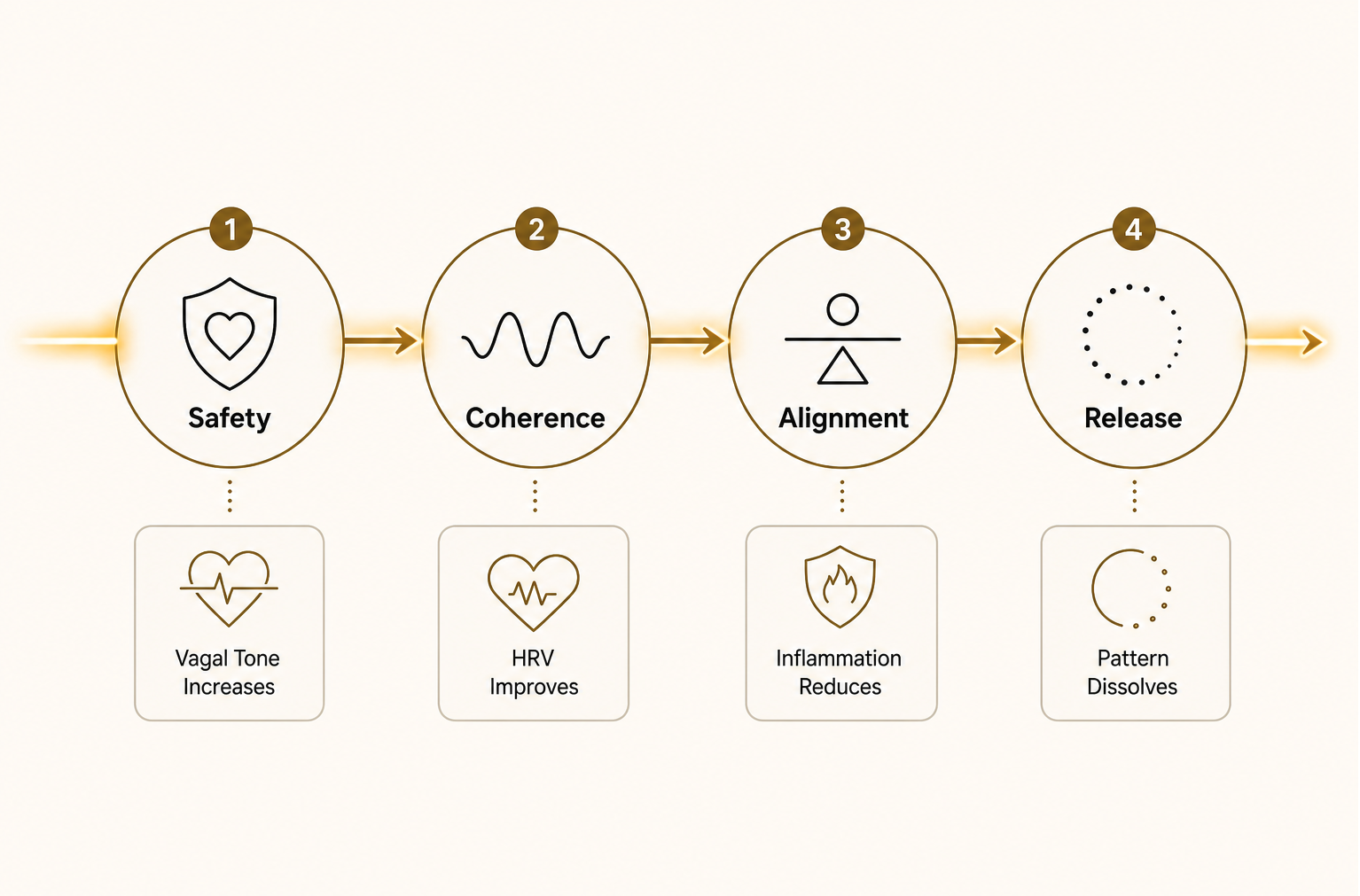
Pathway diagram showing four stages of nervous system healing: Safety (Vagal Tone Increases) → Coherence (HRV Improves) → Alignment (Inflammation Reduces) → Release (Pattern Dissolves), as taken from BODY | MIND IQ (https://www.bodymind-iq.com)
Breathwork as a physiological access point
This is where breathwork becomes crucial. The nervous system has two main branches: the sympathetic (activation) and parasympathetic (calm) systems. You can't directly control either one by thinking about them. You can't decide to activate your parasympathetic system. But you can control one function that both systems influence: your breath.
The breath is the only automatic function under conscious control. Your heart rate, your digestion, your blood pressure - these run automatically. But breathing you can choose. And when you change your breathing pattern, you're sending a direct signal to the nervous system that changes its state.
The vagus nerve - the main parasympathetic highway - is uniquely responsive to the breath. A slow exhale, longer than the inhale, activates the parasympathetic response. This isn't placebo. It's neurophysiology. The vagus nerve has specialized sensory receptors that detect stretch in the airways during exhalation, and this stimulation directly increases vagal tone, telling the nervous system: it's safe. You can relax now.
When you breathe quickly and shallowly - the default when you're stressed - you're essentially sending the opposite signal: threat is near. Stay alert. The nervous system locks in tighter.
Clinical breathwork works by using precise breath patterns to target the nervous system's state in a way that talking, thinking, or even meditation sometimes cannot. The breath isn't metaphorical. It's a direct line to the nervous system.
How altered states of consciousness reach the subconscious
Here's the key insight: the subconscious mind is most accessible when the brain is in specific states.
Your normal waking state is dominated by beta brainwaves (13-30 Hz) - the analytical, problem solving frequency. In this state, the subconscious is heavily gated and new information doesn't easily embed itself. Habitual patterns don't easily change. Conscious thought dominates, and the conscious mind is often too slow or too rigid to access buried material.
But when the brain shifts into theta (4-8 Hz) or alpha (8-12 Hz) states - the frequency of deep meditation, hypnagogic states (the moment before sleep), and REM sleep - something shifts. The gate between conscious and subconscious relaxes. New patterns can be encoded without the constant filtering of the analytical mind and stored memories and patterns become more accessible. The nervous system can literally feel, process, and release material that the conscious mind has been unable to touch.
This is why deep breathwork can feel so different from breathing exercises. A slow breathing exercise might calm you for the duration. But clinical breathwork that's calibrated to shift brainwave states can access the subconscious material itself, the actual stored patterns, not just the surface symptoms.
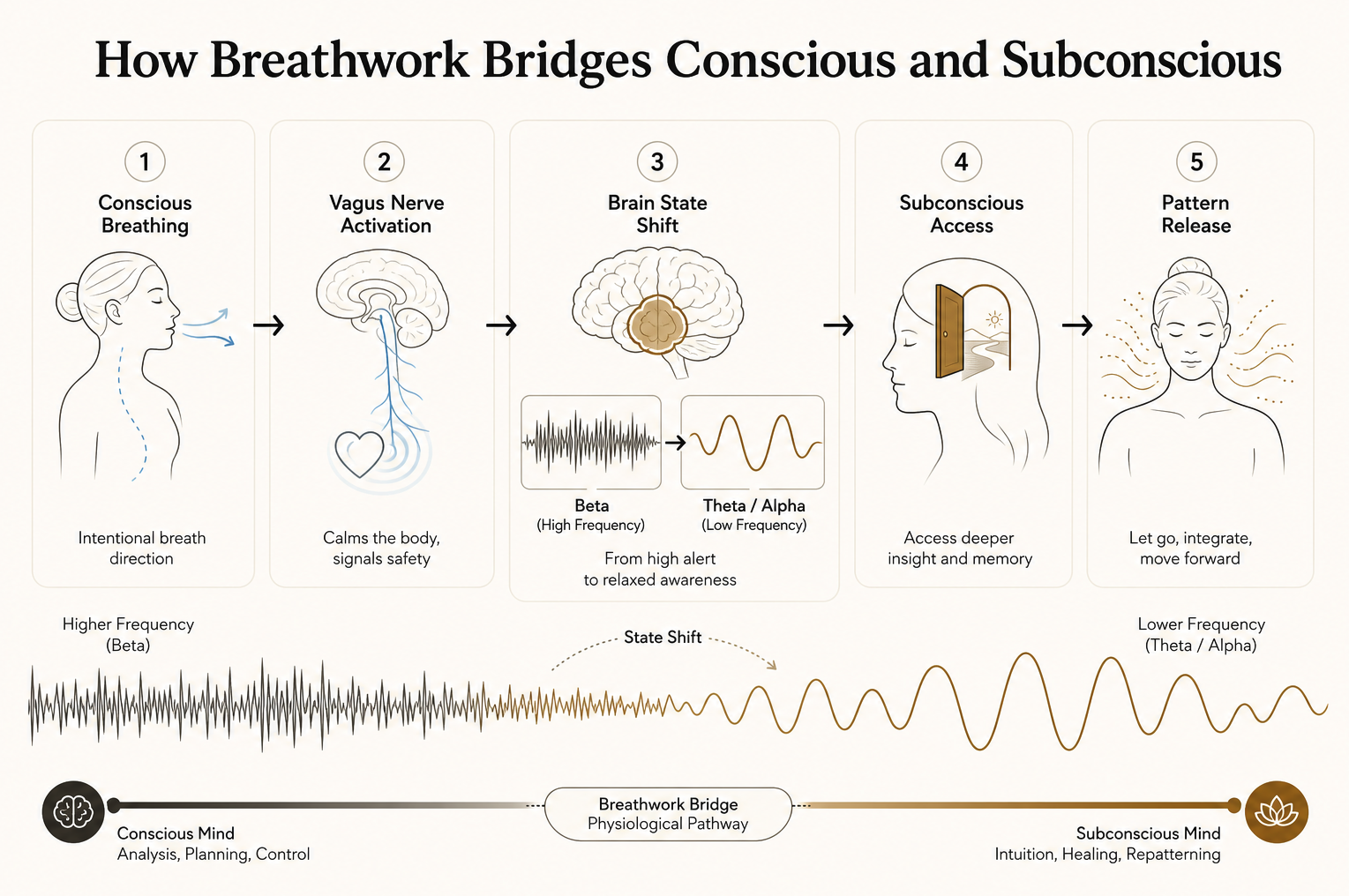
Flow diagram showing how breathwork creates the neurological conditions for subconscious access: Conscious Breathing → Vagus Nerve Activation → Brain State Shift (beta to theta/alpha) → Subconscious Accessibility → Pattern Release, as taken from BODY | MIND IQ (https://www.bodymind-iq.com)
Why childhood patterns show up in the body
There's one more piece to understand: why these subconscious patterns don't just exist as memories or thoughts. Why they live in the body.
Trauma and chronic stress aren't stored as logical narratives in the brain, they're stored as physiological memories. The body literally encodes the experience. A person who was shouted at repeatedly as a child doesn't just have a memory of being shouted at, their nervous system has learned to brace at certain tones of voice. A person who experienced unpredictable physical threat doesn't just remember it - their body is primed to reflexively tense at ambient sounds that echo that threat. The pattern is wired into the nervous system's baseline state.
This is why talk therapy alone sometimes can't resolve these patterns. You can intellectually understand that your parent was doing the best they could, or that you're safe now, and still have your body respond with panic when reminded of the threat. The nervous system has a memory that doesn't go through language.
Breathwork reaches this somatic memory because it works at the physiological level. When the nervous system encounters the safety signal of a slow, regulated breath, especially in the theta state where the subconscious is most accessible, it can begin to reorganise. The nervous system can learn a new pattern, the held tension can release and the alarm can turn off.
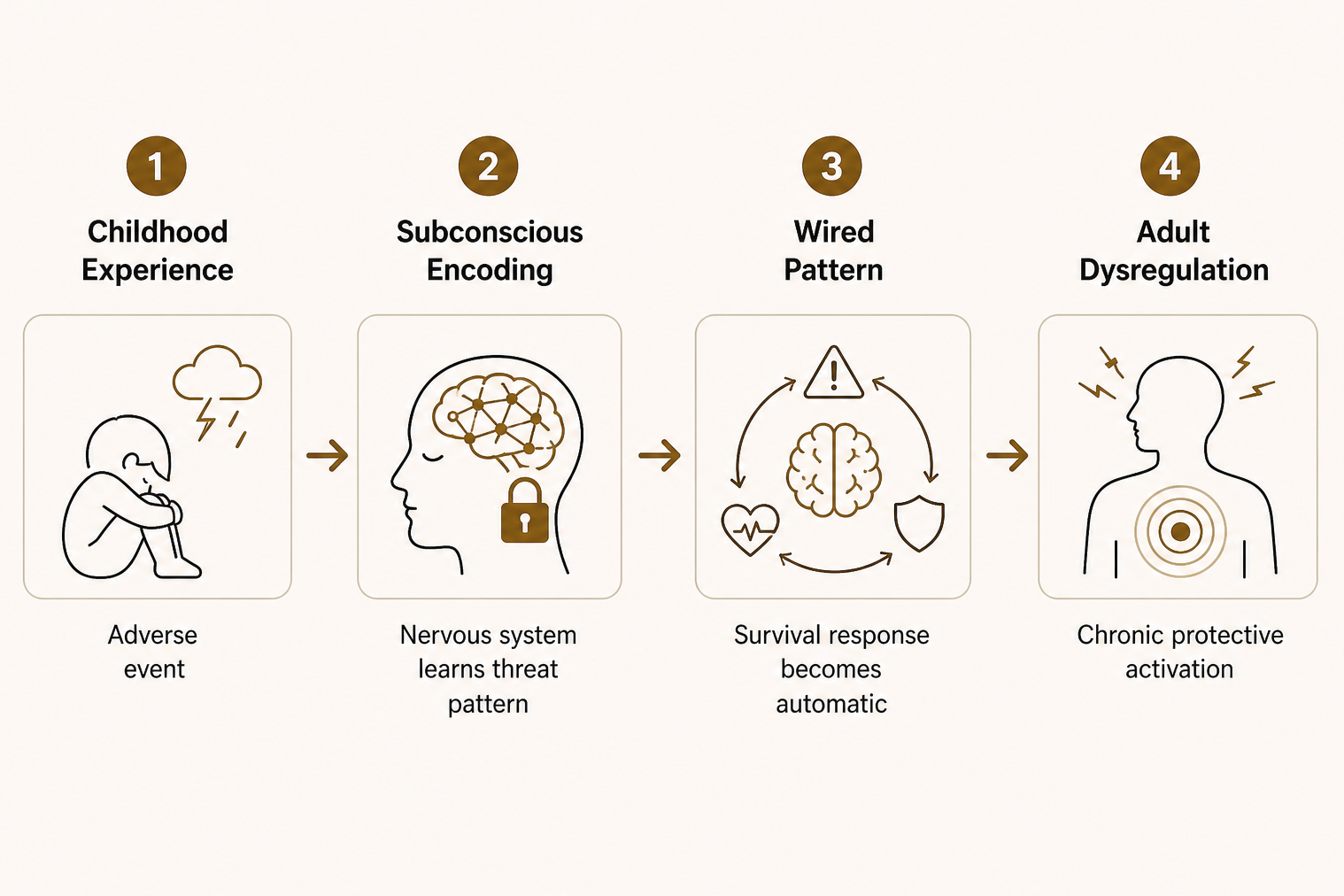
Diagram showing how childhood experiences encode survival patterns into the nervous system: Childhood Experience → Subconscious Encoding → Wired Pattern → Adult Dysregulation. As taken from BODY | MIND IQ (https://www.bodymind-iq.com)
The clinical difference: BODY | MIND IQ breathwork
Not all breathwork is the same. Most instruction focuses on immediate stress relief or a single session's worth of calm. You leave the session feeling peaceful, then life happens, and the nervous system locks back down.
BODY | MIND IQ's approach is clinically calibrated for lasting nervous system change. Bal Matharu, the founder, spent 25+ years as an Advanced Respiratory Physiotherapist in the NHS, this is clinical work, not wellness instruction. For the past several years, she's been conducting PhD research specifically on how breathwork shifts cellular inflammation, nervous system state, and somatic symptom disorders. Every technique in our CORPORATE ECOSYSTEM and EMBODY ECOSYSTEM is grounded in that research, not on instructor certification or marketing claims. A 2023 meta-analysis of 12 randomised-controlled trials found breathwork produced significant reductions in stress compared with control conditions, the calibre of evidence this programme is built from.
The clinical difference shows up in several ways. First in the Embody Ecosystem, the techniques are individualised. Your nervous system state at Phase 1 of the programme is different from your state at Phase 3. The breathwork you need in the beginning, when you're still highly dysregulated, is different from the breathwork you need once you've achieved baseline regulation. BODY | MIND IQ adapts the practice as your nervous system evolves.
Second, every intervention in both Ecosystems is measured. Pre and post assessments track vagal tone, HRV, inflammatory markers, sleep quality, and symptom changes. You don't just feel better; you have data showing that your physiology has actually shifted. This matters, it means you're not relying on subjective experience or faith in the process. The nervous system's own measurements confirm the change.
Third, the practice is trauma-informed. Breathwork can trigger somatic release, the body completing protective responses it's been holding for years and this can be intense. The difference between clinical breathwork and general breathwork is that clinical work knows how to create a regulated container, how to titrate the intensity so the nervous system never goes into overwhelm, and how to support the integration after release. Bal's clinical background ensures that every person remains within their window of tolerance, never pushed beyond what their nervous system can process.
What happens when patterns begin to release
When someone begins clinical breathwork practice, the first weeks or months are usually about building a sense of safety. The nervous system is learning that this breath centred practice is a safe place to exist, sessions feel calming, sleep improves and the baseline anxiety drops slightly.
Then, as practice deepens and the nervous system relaxes further, something else begins to happen. Stored patterns start to surface and a person might find themselves crying during a session for no conscious reason, but their body is releasing years of unexpressed grief. Someone else might feel intense heat or vibration in their body, the nervous system completing a protective response it's been holding. Another person might suddenly have a sense memory, not a full conscious memory, but a felt sense of a childhood moment of fear, and as they continue breathing, the nervous system releases it.
This is the phase where breathwork moves from symptom relief into genuine healing. The nervous system is meeting the subconscious patterns stored in the body, and those patterns are dissolving.
The release process may bring up emotions, all are part of the process and what the nervous system needs to experience to let them go. The nervous system has been holding these patterns because it believed they were protective. When a new signal comes in, the safety of slow breath in a regulated container, the nervous system can begin to loosen its grip. The patterns may not disappear instantly, usually they release in layers. And as they release, the nervous system discovers that it doesn't need them, that it's safe to operate without them.
EMBODY ECOSYSTEM
Over the course of a full 12-month programme like the EMBODY ECOSYSTEM, participants move through this arc. Early phases establish foundation and safety. Middle phases activate somatic release and deep integration. Later phases solidify new baselines and teach the person how to sustain nervous system regulation as a lifelong practice.
By the end, measurable changes have accumulated. HRV has improved significantly. Inflammatory markers have dropped, sleep is genuinely restorative, energy is back and the person has a lived sense of what regulation feels like, because they're living in it.
CORPOTATE ECOSYSTEM
Over the course of the Corporate Ecosystem's eight sessions, participants move through a similar arc. Session one opens with a clinical breathing assessment that maps each leader's current pattern and hands them working tools from day one. The middle sessions build physiological capacity and work directly with the threat responses underneath perfectionism, avoidance and the fusion between identity and role and the patterns leadership development usually mistakes for personality, and tries to fix with the wrong tools. The final sessions rebuild presence, trust and boundaries, closing with a Lifestyle Medicine session and a personalised health consultation for every participant.
By the end, HRV and vagal tone have measurably improved, pre- and post-programme health markers are on record, and leaders are running their teams from capacity rather than depletion, not because they were told to manage stress better, but because their physiology actually changed.
The role of cellular alignment
Throughout this process, something subtle but profound is happening at the cellular level. When the nervous system shifts from chronic sympathetic activation to regulated parasympathetic tone, the cells of the body get a new signal: it's safe to repair now.
Immune function normalizes. Inflammatory cascades wind down. The body can allocate resources to digestion, hormone production, muscle repair, and cellular regeneration - all the processes that happen in the parasympathetic state and that have been suppressed for years.
This is what "cellular alignment" means. It's not a mystical concept. It's the basic physiology of what happens when a nervous system stops sending constant alarm signals and instead sends signals of safety. The cells respond. The body repairs.
Why coaching and community matter in nervous system healing
One last point: nervous system healing rarely happens in isolation. The nervous system is fundamentally relational. We co-regulate with other nervous systems. In a supportive group, in a clinical container with a practitioner who models regulation, the nervous system learns something it couldn't learn alone: what regulation in another person feels like, and how that can affect your own state.
This is why BODY | MIND IQ's programmes - whether individual or corporate - emphasize the importance of consistent, skilled guidance. A practitioner who is themselves deeply regulated, who understands the nervous system at a clinical level, whose presence is regulated - that nervous system becomes a model for the client or participant. The nervous system learns not just from technique, but from proximity to another nervous system at rest.
Try BODY | MIND IQ
For individuals ready to work at this depth, not symptom management, but physiological redesign - the EMBODY Ecosystem is a 12-month clinical programme with regular breathing sessions led personally by Bal Matharu, nervous system education, somatic integration support, health marker assessments, and lifestyle medicine foundations. It's designed specifically for high-performing individuals managing chronic fatigue, burnout, or nervous system dysregulation who have tried other approaches and are ready to address the root cause at the cellular level.
For founders and organisations carrying this same load across a team, the Corporate Ecosystem is where that work happens at scale - most directly through the Workforce Capacity Programme, our eight-session, four-month clinical model for founding teams and full leadership cohorts, with pre- and post-programme physiological measurement and reporting back to the business. Executive Breathwork is also available for senior leaders who want to work 1:1 outside a cohort.
The entry point for either is a no-obligation clarity call with Bal to assess fit and individual needs. Every intervention is grounded in the same clinical principle: genuine nervous system healing shows up in the data.
Frequently Asked Questions
-
The survival patterns driving anxiety are encoded in the subconscious nervous system - below the level of conscious thought. Decades of research on unconscious processing confirm that most judgment and behavioural guidance is generated outside conscious awareness, with the conscious mind often making sense of decisions after they're already in motion rather than originating them. Willpower and positive thinking operate at the conscious level and cannot override patterns wired at the subconscious level. Polyvagal theory demonstrates that physiological state change - through breathwork, somatic work, or regulated nervous system input - is required to access and shift these patterns.
-
Cellular healing refers to measurable physiological changes that reflect genuine nervous system restoration: improved Heart Rate Variability (HRV), reduced inflammatory cytokines, restored vagal tone, and balanced cortisol rhythms. These are the biological markers of a nervous system that has shifted from chronic survival mode to regulated function. Talk therapy and mindset work don't reliably shift these markers; breathwork and somatic approaches that work directly with the autonomic nervous system can.
-
Specific breathing patterns shift brain activity from beta (waking, analytical) to theta and alpha states - the same frequency range associated with deep meditation, hypnagogic states, and REM sleep, where subconscious pattern consolidation and access are most accessible. In this state, the nervous system's habitual filtering reduces, allowing buried patterns to surface safely. Recent neuroscience research confirms that high-ventilation breathwork can evoke altered states of consciousness with identifiable neurobiological signatures.
-
Clinical breathwork, delivered by a qualified practitioner in a regulated environment, is considered safe for trauma processing - and in some cases more appropriate than purely verbal approaches, since trauma is stored somatically (in the body) rather than as explicit memory. The key is physiological safety: the nervous system must feel regulated before it can release. BODY | MIND IQ's approach, grounded in Bal Matharu's 25+ years of NHS clinical experience and active PhD research, is designed to create and maintain this regulated container throughout each session.
-
Most breathwork classes teach techniques for immediate stress relief or peak performance - valuable, but working at the surface level. Clinical breathwork, as practised at BODY | MIND IQ, is physiologically calibrated to shift the nervous system through specific states toward genuine dysregulation resolution, with pre/post measurement of HRV, inflammatory markers, and vagal tone. The practitioner's background matters significantly: Bal Matharu is an Advanced Respiratory Physiotherapist with 25+ years NHS clinical experience and active PhD research specifically in breathwork and nervous system science - not a wellness instructor certification.
“The patterns were installed a long time ago, without your consent. Releasing them doesn’t require reliving them, just a nervous system finally given the evidence that it’s safe to stop.”