
Breathwork vs. Breathing Exercises
They Are Not the Same Thing and Understanding is a Game Changer
Most people use the terms breathwork and breathing exercises interchangeably. I understand why, both involve the breath, both are intentional, and both have been shown to support wellbeing. But they work through entirely different mechanisms, target different systems in the body, and produce different outcomes.
Getting clear on the distinction is not just a matter of terminology. It determines what practice you choose, when you use it, what you can expect from it, and critically, whether you are using the right tool for what you actually need.
I have been working in the respiratory space for years , and this is one of the most common sources of confusion I encounter. So let me break it down properly, with the science behind both.
The Case for Breathing Exercises: Daily Regulation and Nervous System Health
Breathing exercises are exactly what the name suggests: structured techniques designed to train and correct how you breathe day to day. Most of us have developed unconscious breathing habits, shallow chest breathing, over-breathing, mouth breathing, that keep the nervous system in a low grade state of alert. Breathing exercises are the corrective.
The primary mechanism here is parasympathetic activation. Slow, diaphragmatic breathing, typically at around six breaths per minute, directly stimulates the vagus nerve, shifting the autonomic nervous system away from sympathetic dominance (fight or flight) and toward the rest and digest state that the body needs to repair, regulate, and function optimally.
The research on this is robust and increasingly well documented. A study published in Scientific Reports found that even a single session of deep, slow breathing produced significant improvements in vagal tone and reductions in anxiety across both younger and older adults. Multiple studies confirm that diaphragmatic breathing increases heart rate variability (HRV) parameters, in some trials by 21 to 46%, a physiological marker strongly associated with resilience, emotional regulation, and cardiovascular health.
The techniques themselves are accessible, well evidenced, and designed to be used regularly, woven into daily life rather than reserved for a special session.
Three Techniques Worth Knowing
Diaphragmatic Breathing
Place one hand on your chest, one on your belly.
Inhale slowly through your nose, your belly should rise, your chest stays relatively still.
Exhale fully and slowly, feeling the belly fall.
Practice for 5–10 breaths.
This is the foundation of all regulation-based breathing.
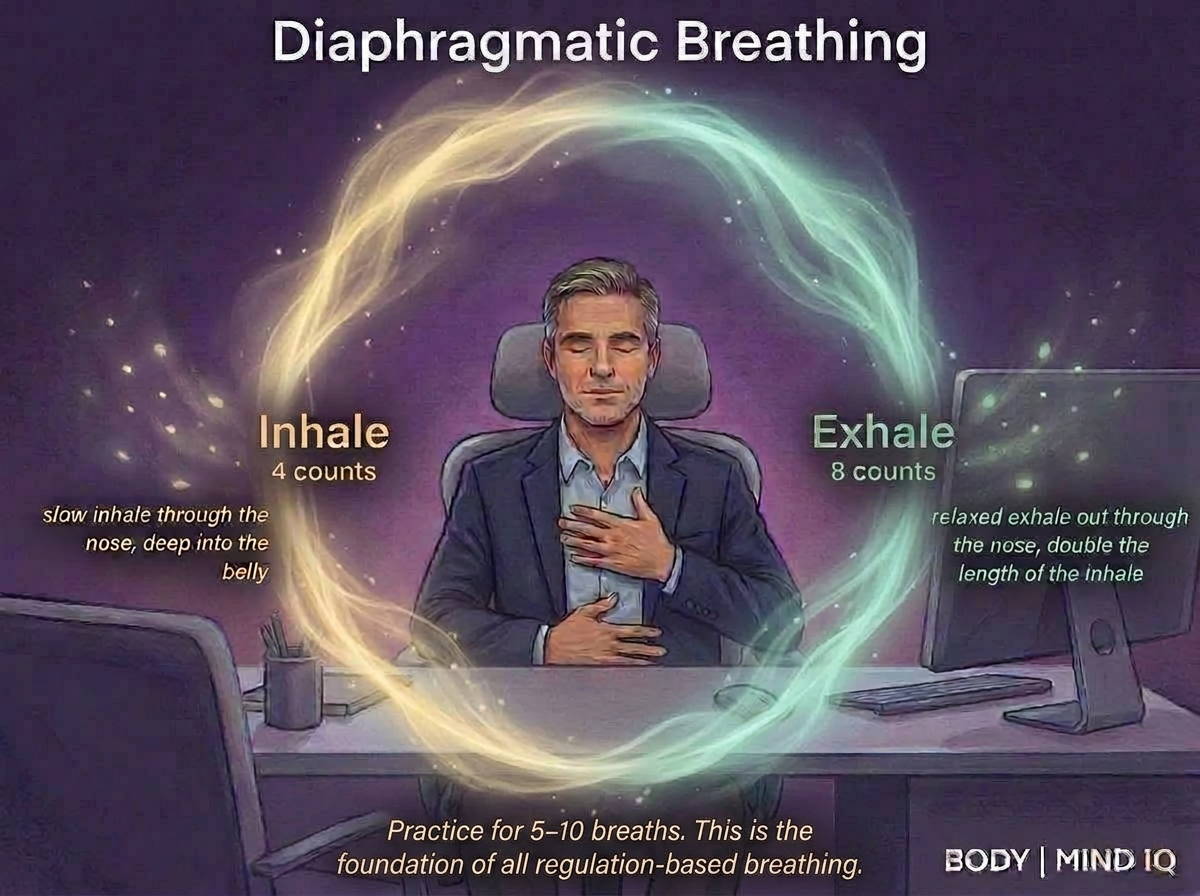
Diaphragmatic Breathing
Box Breathing (Used by Navy SEALs, surgeons, and high performance athletes)
Inhale for a count of 4.
Hold for a count of 4.
Exhale for a count of 4.
Hold for a count of 4.
Repeat for 4–5 cycles.
Used before high stress situations to centre the nervous system.
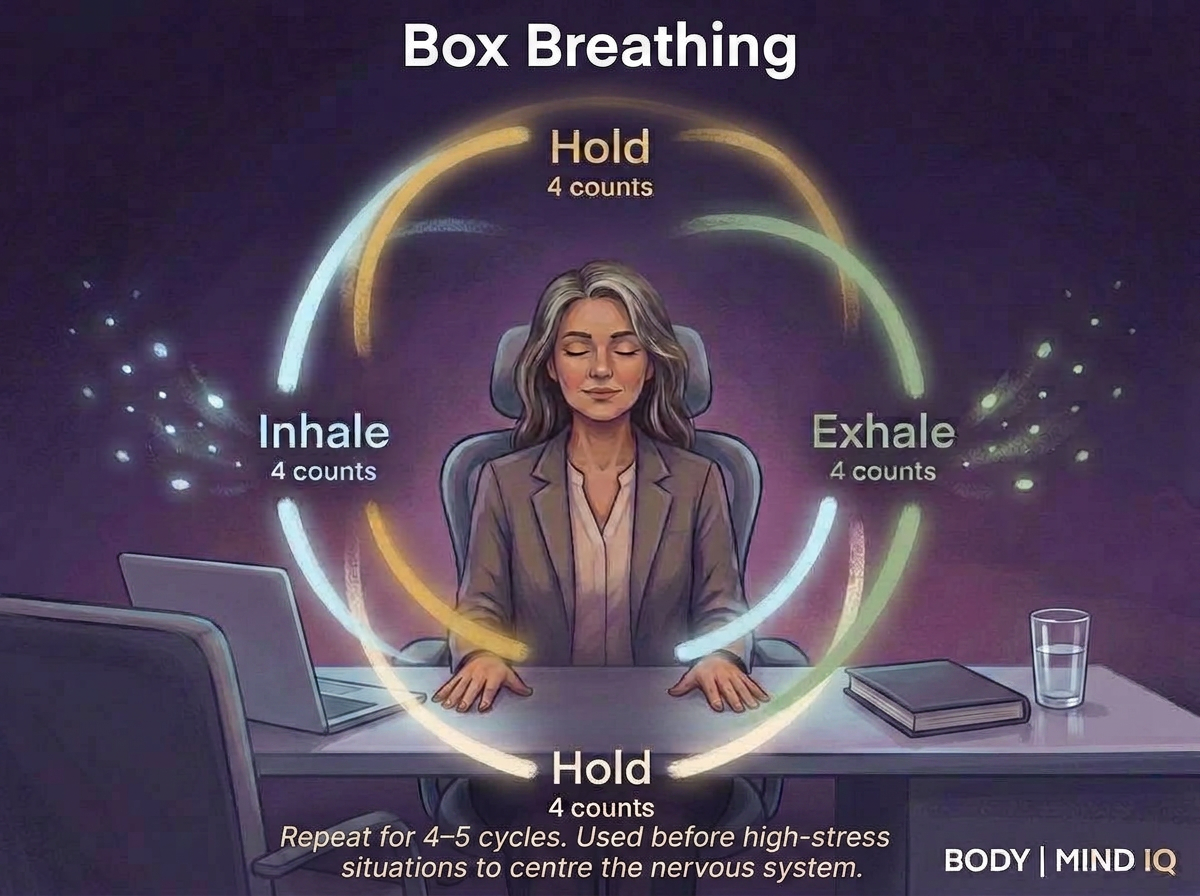
Box Breathing
4–7–8 Breathing (Dr. Andrew Weil's technique, backed by clinical research)
Inhale quietly through your nose for 4 seconds.
Hold your breath for 7 seconds.
Exhale completely through your mouth for 8 seconds.
Repeat for 4 cycles.
A 2024 scoping review of 15 studies found the 4-7-8 technique significantly reduces cortisol, anxiety, and blood pressure through vagal pathway activation.
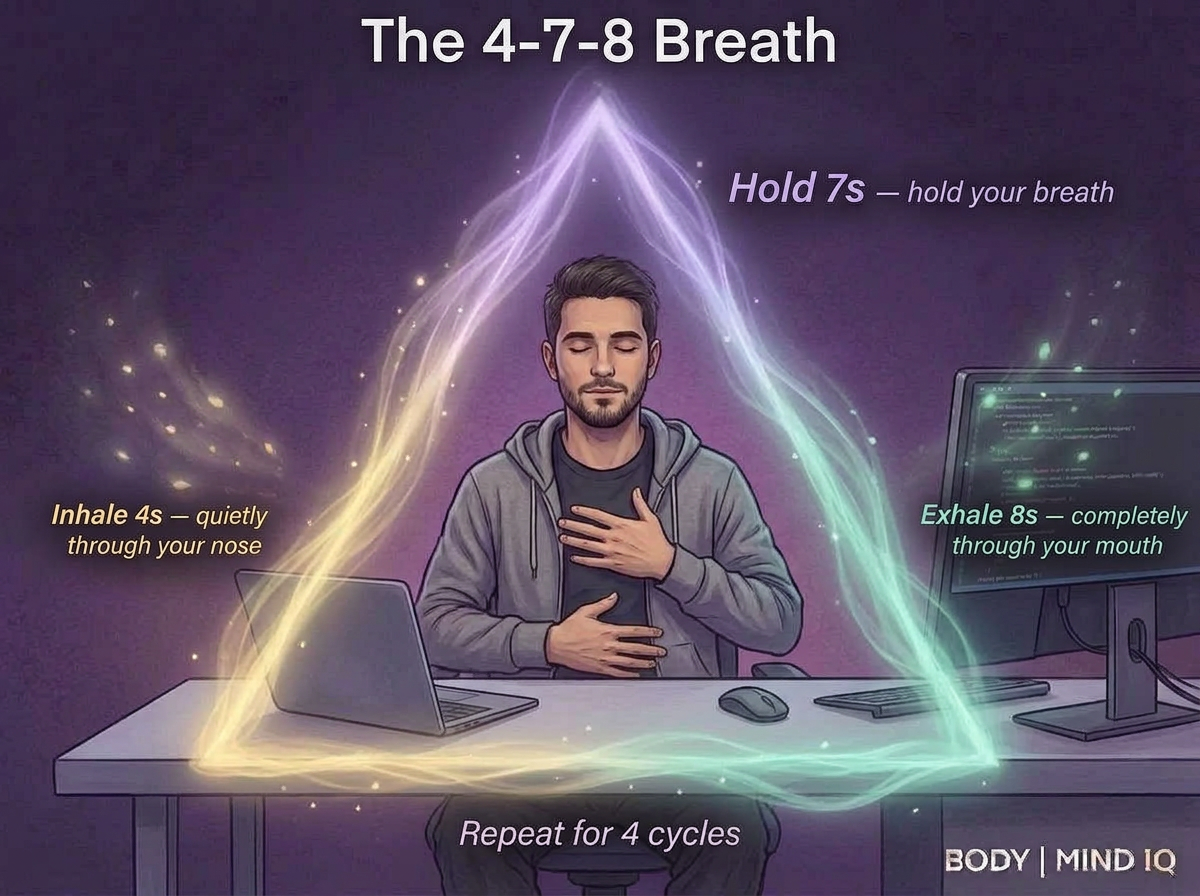
The 4-7-8 Breath
“Slow, nasal, diaphragmatic breathing has been shown to significantly improve vagal tone, HRV, and emotional control, while reducing cortisol, anxiety, and stress.
This is not wellness. This is physiology.”
The Case for Breathwork: Going Deeper
Breathwork is something different. Where breathing exercises work gently and continuously with the parasympathetic system, breathwork, particularly the more intensive modalities, works through deliberate, often amplified breathing patterns to produce significant physiological and psychological shifts. These are not everyday maintenance tools. They are transformative practices.
The most well known breathwork modalities include Holotropic Breathwork (developed by Stanislav and Christina Grof), Transformational Breath, and the Wim Hof Method. What they share is the use of sustained, often accelerated breathing to move the body through distinct physiological states, temporarily shifting blood gases, activating deeper layers of the nervous system, and creating the conditions for emotional release, trauma processing, and altered states of awareness.
This is where the evidence is particularly compelling.
A 2023 meta analysis published in Nature's Scientific Reports, one of the most rigorous analyses of breathwork to date, reviewed 12 randomised controlled trials involving 785 participants and found that breathwork produced significant reductions in self-reported stress (effect size g = -0.35), anxiety (g = -0.32), and depressive symptoms (g = -0.40). These are meaningful clinical effect sizes, not marginal ones.
Research into Holotropic Breathwork specifically has documented its use in trauma resolution, PTSD, and emotional processing. Studies at Johns Hopkins have explored its potential for veterans with PTSD, while published clinical work demonstrates its capacity to help individuals access and integrate suppressed emotions through a non pharmacological, body based approach.
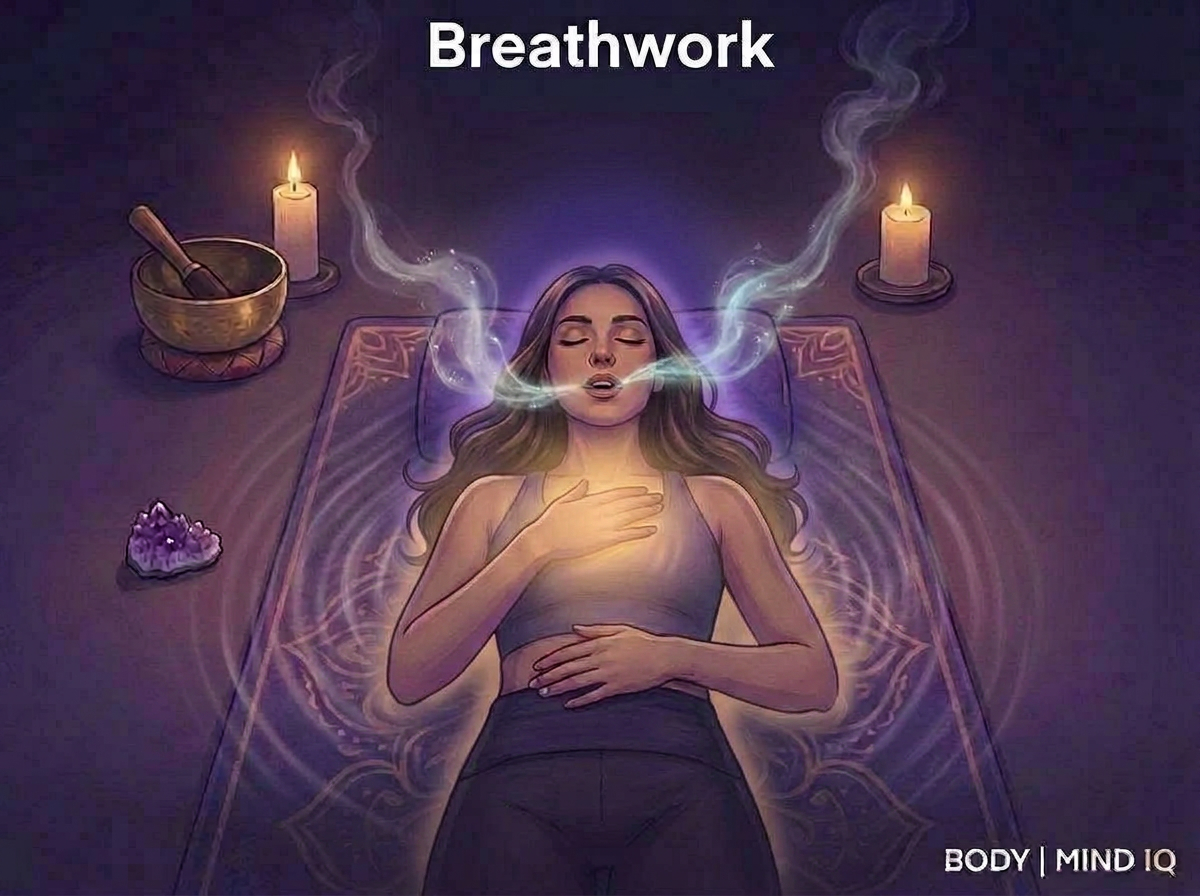
Breathwork
The mechanism is distinct from breathing exercises. Intense breathwork temporarily alters CO2 levels and blood pH, activating the sympathetic nervous system in a controlled way, allowing the body to move through a stress cycle to completion rather than suppressing it. What follows is often a significant release, followed by a deep parasympathetic rebound: that’s the profound calm that many people report after a breathwork session.
“Breathwork produced significant reductions in stress, anxiety, and depressive symptoms across 12 randomised controlled trials. The effect sizes are clinically meaningful.”
The Key Difference: Tool vs. Transformation
Here is how I like to think about it.
Breathing exercises are your daily infrastructure. They are the practice that trains your nervous system over time, building greater HRV, improving stress response, creating a baseline state of regulation that changes how you show up every day. Five minutes of diaphragmatic breathing in the morning is not dramatic. But done consistently over weeks and months, it rewires your autonomic nervous system in ways that are genuinely measurable.
Breathwork, by contrast, is a deeper intervention. It is what you reach for when you need to move something, when stress has accumulated beneath the surface, when emotional material needs processing, when you want to access a different level of clarity or release. A good breathwork session takes you somewhere your daily practice does not. It works at the level of the body's stored experience, not just its current state.
Both are valid in their own way and both are powerful. The mistake is using one when you need the other or dismissing either because you have not yet understood what it is actually designed to do.
How BODYMIND IQ Uses Both
At BODYMIND IQ, our work is built on the understanding that the breath is the most direct access point we have to the nervous system and that different practices serve different purposes within a complete approach to human performance and health.
We use evidence based breathing techniques as foundational tools, building daily regulation capacity, improving HRV, and giving individuals a physiological resource they can access anywhere, at any time. For our corporate clients, this means equipping leaders and teams with the in the moment tools that genuinely move the needle on stress, decision making, and presence.
We also use structured breathwork for the deeper work: building the capacity to process, release, and integrate, the kind of work that changes how someone relates to pressure, not just how they manage it in the moment.
The breath is with you every moment of every day. Learning to use it with intention, really use it, not just breathe at it, is one of the most powerful investments you can make in your own health, performance, and quality of life.
Whether you are just beginning to explore conscious breathing or you are ready for the deeper work, both paths are worth walking. They are just heading toward different, complementary parts of the same destination.
References
Fincham, G.W. et al. (2023). Effect of breathwork on stress and mental health: A meta-analysis of randomised-controlled trials. Scientific Reports (Nature). https://www.nature.com/articles/s41598-022-27247-y
Zaccaro, A. et al. (2018). How Breath-Control Can Change Your Life: A Systematic Review on Psycho-Physiological Correlates of Slow Breathing. Frontiers in Human Neuroscience.
Magnon, V. et al. (2021). Benefits from one session of deep and slow breathing on vagal tone and anxiety in young and older adults. Scientific Reports. https://www.nature.com/articles/s41598-021-98736-9
Shaffer, F. & Ginsberg, J.P. (2017). An Overview of Heart Rate Variability Metrics and Norms. Frontiers in Public Health. [HRV parameters increase 21–46% with diaphragmatic breathing]
Rathore, M. et al. (2024). Exploring 4-7-8 Breathing for Stress Relief and Improved Quality of Life. Scoping Review of 15 studies (2013–2024). ICIS Tech Proceedings.
Grof, S. & Grof, C. (1989). Holotropic Breathwork: A New Approach to Self-Exploration and Therapy. Foundational framework for Holotropic Breathwork modality.
Heller, A.S. et al. (2020). Slow breathing and autonomic cardiac modulation. Frontiers in Neuroscience. [Vagal activation at 6 breaths/minute]
Porges, S.W. (2011). The Polyvagal Theory. Norton. Foundational neuroscience of vagal tone and co-regulation.