
There is a metric that does not appear on any dashboard. It does not show up in a quarterly review or a 360 assessment. Yet the research is unambiguous: it is one of the most powerful predictors of your cognitive output, decision quality, and strategic thinking
It is how well you slept last night
The Numbers Leaders Need to See
The RAND Corporation conducted one of the most comprehensive analyses of sleep and economic output ever published. Their findings: insufficient sleep costs the United States $411 billion per year, equivalent to 2.28% of GDP, with an estimated 1.23 million working days lost annually. The UK, Germany, and Japan carry comparable losses proportional to their economies.
More striking for anyone in a leadership role: managers, on average, get just 6.5 hours of sleep per night. That is below the 7–9 hour threshold recommended by sleep science, and well into territory that researchers associate with meaningful cognitive impairment.
A person sleeping fewer than six hours per night carries a 13% higher mortality risk than someone sleeping seven to nine. But long before mortality, there is a quieter cost, the gradual erosion of the very capacities that leadership demands.
What Sleep Deprivation Does to the Executive Brain
A 2025 meta-analysis synthesising data from 39 studies and over 4,500 participants confirmed what neuroscientists have argued for years: sleep deprivation selectively impairs executive function, the cluster of cognitive abilities that includes working memory, inhibitory control, decision-making, and cognitive flexibility. These are not incidental skills, but they are the core of what leaders do.
The mechanism is well understood. Sleep loss reduces cerebral metabolism in the prefrontal cortex, the region of the brain governing judgment, impulse control, and complex reasoning. A 2025 review published in Frontiers in Neuroscience found that cognitive flexibility, which underpins adaptability and creative problem solving, is among the functions most vulnerable to sleep restriction.
A consistent pattern emerges across the literature: when sleep deprived, people revert to habitual, automatic responses rather than goal-directed thinking. Creative processes suffer more than rule based ones. Decision speed may feel unchanged, but accuracy and quality deteriorate, often without the individual noticing. That last point may be the most dangerous element of all.
Harvard researchers note that after even a single night of poor sleep, emotional regulation drops alongside decision making and innovation. Research from the American Psychological Association has found that sleep loss specifically impairs emotional intelligence, empathy, and conflict management, foundational to how leaders engage their people and culture.
The Sleep Performance Framework: AWE
The research consistently points to three high leverage areas for improving sleep quality. Together, they form a practical, evidence based framework built for people with demanding schedules.
A — Anchor Your Wake Time
Set a consistent wake time and hold it seven days a week, regardless of when you fell asleep. This is the single most evidence-supported lever for regulating the circadian system. Varying your wake time, even by 60 to 90 minutes across the week, introduces what researchers call social jetlag, which fragments sleep architecture and reduces restorative depth.
W — Wind Down the Final Hour
Build a 60-minute buffer before bed that signals to the nervous system that the day is over. No screens in the final 45 minutes (blue light suppresses melatonin), no alcohol within three hours of sleep (alcohol sedates but disrupts REM), and a deliberate reduction in cognitive load. This is not ritual for its own sake, it is preparation for the physiological processes that only occur in deep sleep: memory consolidation, cellular repair, and glymphatic clearance of metabolic waste from the brain.
E — Environment Audit
The sleep environment communicates directly to the body. Research consistently identifies three critical variables: temperature (most adults sleep optimally between 18°C and 20°C), darkness (blackout conditions or a sleep mask), and sound (quiet or consistent low level noise). These are not luxuries, they are inputs to a biological process that governs your performance the following day.
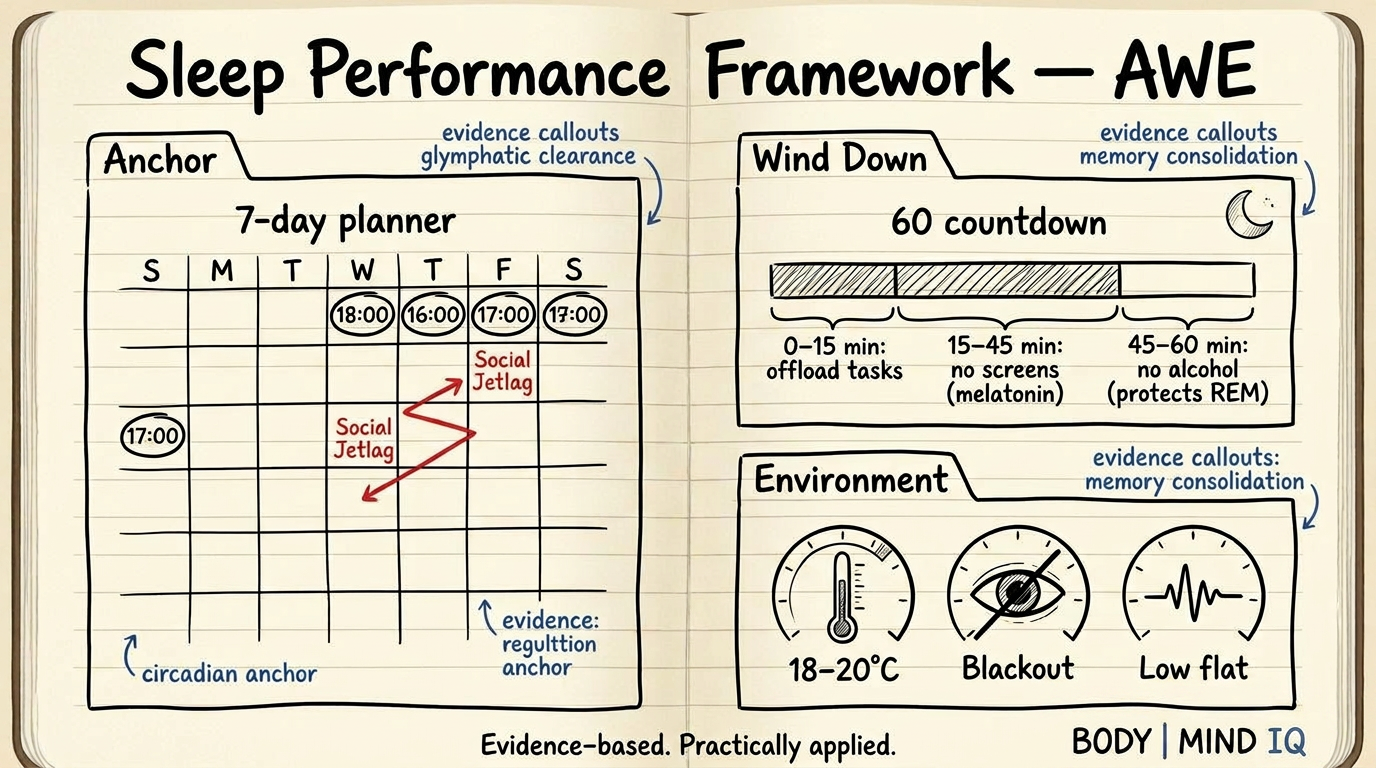
The AWE Framework - Anchor, Wind Down and Environment
The Case for Taking This Seriously
Sleep is not a wellness trend. It is a foundational physiological process and in the context of executive performance, it may be the most underutilised performance lever available.
The evidence is no longer just emerging, it has arrived. The question is whether leaders choose to act on it.
At BODYMIND IQ, our corporate programmes address sleep as a core pillar of human capital, not as a footnote to a wellbeing initiative. Because when cognitive capacity is the product, protecting sleep is a executive business decision.