
I want to start this blog with something I hear all the time.
From leaders. From high achievers. From people who have given everything to their work and are running on fumes but still showing up, still performing, still pushing through.
"I am just tired. I will be fine once things calm down."
And the truth if the matter is as you well know, things rarely calm down. And what is being described, that bone deep tiredness, the quiet detachment, the feeling that you are going through the motions but something has gone, is not just tiredness. It has a name, a clinical definition, a well documented physiological mechanism, and it is currently affecting people at a scale the world has not seen before.
What Burnout Actually Is And Where It Came From
The word burnout was first used clinically in 1974 by American psychologist Herbert Freudenberger, who used it to describe what he was observing in workers in the helping professions, doctors, nurses, social workers, people who had given so much of themselves that they had, in his words, burned out like a candle that had nothing left to give.
In 1981, psychologist Christina Maslach developed the Maslach Burnout Inventory (MBI), the first scientifically validated tool to measure burnout. Her research defined burnout across three dimensions that remain the clinical standard today: exhaustion, cynicism, and reduced professional efficacy. Not one of these alone. All three, in combination, as a response to chronic, unmanaged workplace stress.
In 2019, the World Health Organisation formally included burnout in the International Classification of Diseases (ICD-11), not as a medical condition, but as an occupational phenomenon. That distinction matters. It means burnout is recognised as a direct product of the work environment, not a personal failing or a weakness of character.
The WHO defines it as the result of chronic workplace stress that has not been successfully managed, characterised by feelings of energy depletion or exhaustion, increased mental distance from one's job, cynicism, negativism and reduced professional efficacy.
“Burnout is not a personal weakness. It is a physiological response to a system that demands more than it gives back. The WHO formally recognised this in 2019. We are still catching up.”
The Three Faces of Burnout, What It Actually Looks Like
One of the reasons burnout is so often missed, both by the person experiencing it and by the organisations responsible for their wellbeing, is that it does not arrive all at once. It creeps…and it wears different faces depending on who it is affecting.
Exhaustion
This is the first and most visible dimension. Not tiredness that sleep fixes. The kind of fatigue that is still there when you wake up. The kind that makes ordinary tasks feel disproportionately effortful. The kind that sits in the body — in the heaviness of limbs, the slowness of thought, the inability to recover even during rest. Physically, this is the body running on a depleted HPA axis — the hypothalamic-pituitary-adrenal system that governs our stress response — producing cortisol in irregular, dysregulated patterns after months or years of chronic activation.
Cynicism and Detachment
This is the nervous system's protective response to exhaustion. When we can no longer sustain care and engagement, the psyche creates distance. Work that once felt meaningful starts to feel hollow. People you used to connect with become sources of irritation. Goals that used to drive you no longer land. This is not an attitude problem. Research describes it as a coping mechanism — the mind's attempt to reduce exposure to the source of depletion. It is a signal, not a character flaw.
Reduced Efficacy
The third dimension is the quietest and often the most painful. The loss of confidence in your own competence. The sense that you are no longer the person you were — that your best work is behind you, that you are not as sharp, not as capable, not as effective. This is what burnout does to professional identity. And it is deeply personal.
Maslach's research shows these three dimensions interact and compound each other. Exhaustion feeds cynicism. Cynicism erodes efficacy. Reduced efficacy deepens exhaustion. It is a cycle, and without intervention at the right level, it perpetuates itself.
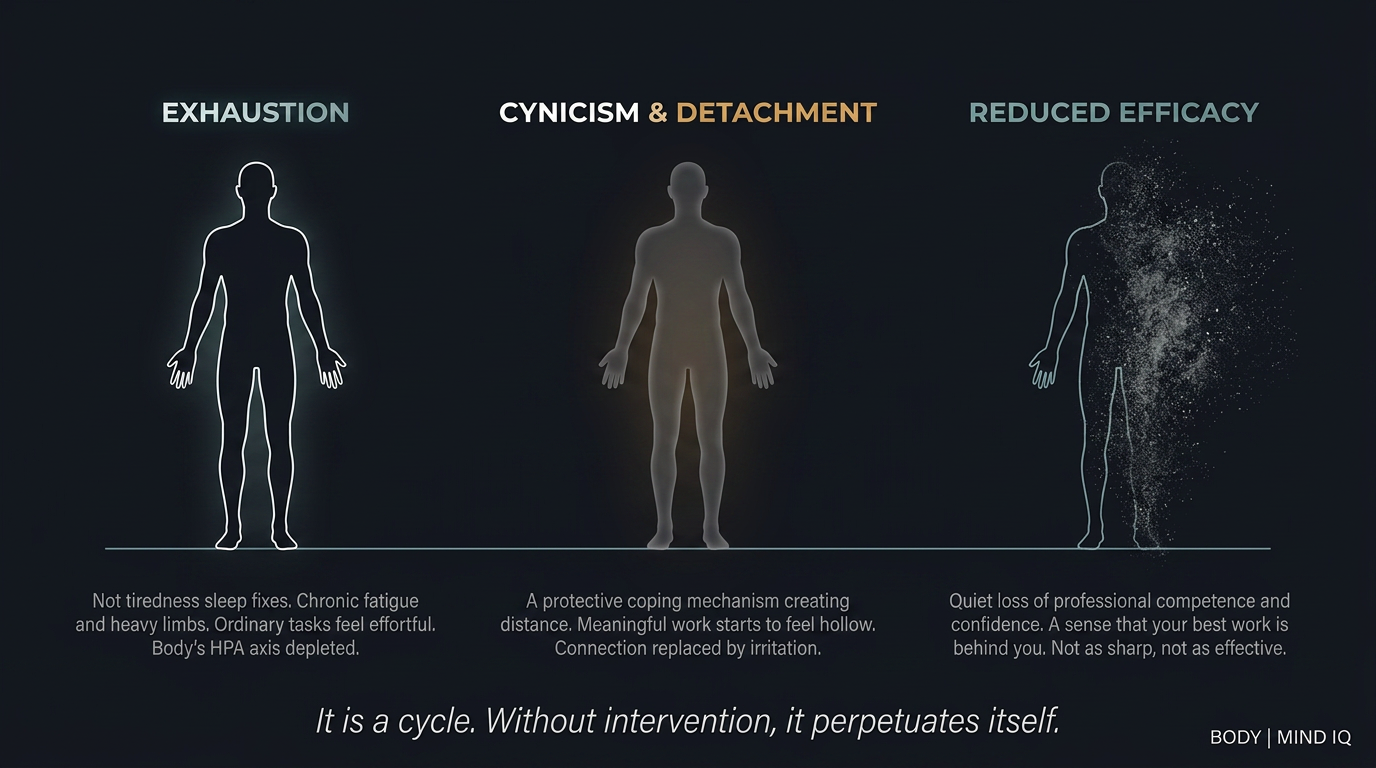
The three faces of burnout
The Scale of the Problem Right Now
I want to be direct about the numbers because they need to land.
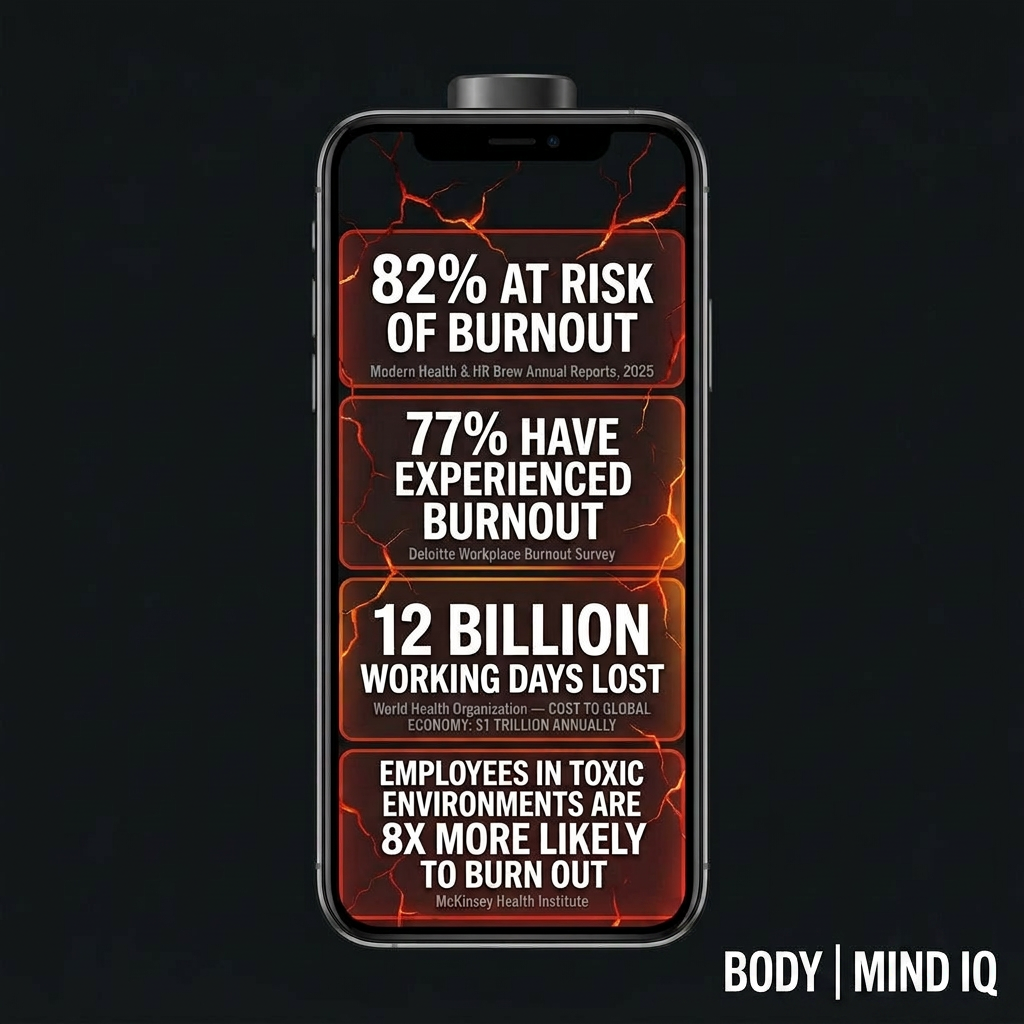
The startling numbers on burnout right now
Women are reporting burnout at 59% compared to 46% for men, a gap that has more than doubled since 2019.
Gen Z and millennials are now hitting peak burnout at age 25, a full 17 years earlier than previous generations. This is not a marginal health issue, this is an epidemic running through the heart of the working population.
And the leadership picture is particularly sharp.
Gallup's 2025 State of the Global Workplace report found that manager engagement dropped from 30% in 2023 to 27% in 2024.
The very people responsible for holding team wellbeing are struggling to hold their own. A
2022 Deloitte study found that 70% of C-suite executives had considered leaving their roles because of burnout.
“The very people responsible for holding team wellbeing are burning out themselves.
And when the leaders at the top are running on empty, the whole organisation feels it.”
Why Is Burnout Showing Up Now More Than Ever?
This is the question I get asked most often, and it deserves an honest answer.
Burnout is not new. But the conditions for it have never been more concentrated than they are right now, several forces have collided to create a perfect storm.
The first is the ‘always on’ culture that technology has enabled. The boundary between work and rest, which was never strong enough, has been almost entirely erased. Smartphones, Slack, email after hours, the expectation of availability across time zones, all of it keeps the nervous system in a state of low grade activation that never fully resolves. And thus chronic stress remains in a state of constantly switched on despite the absence of an acute threat.
The second is the lasting neurological impact of the pandemic. Research published in 2024 shows that the sustained uncertainty, isolation, and hypervigilance of the pandemic years created epigenetic changes, actual modifications to how genes involved in the stress response are expressed. We are not simply tired from a difficult few years, for many people, the architecture of their stress response has shifted.
The third is structural. Gallup's data shows that workload, understaffing, and poor leadership account for the top reported causes of workplace stress. Organisations have asked more of their people, more flexibility, more adaptability, more resilience, without always providing the conditions, resource, or recovery time that genuine resilience requires.
And underneath all of it is something that rarely gets named: the stories and identities people build around performance and productivity. The belief that rest is weakness. That worth is earned through output. That stopping (even briefly) is dangerous. These are not just cognitive beliefs, they are patterns held in the body, in the nervous system, in the way a person braces, holds their breath, and keeps going long past the point their biology is telling them to stop.
The Physiology Nobody Tells You About
Understanding burnout at the level of the body changes everything. Because most interventions, well meaning as they are, address the conscious, cognitive symptoms without touching the physiological root.
Burnout is, at its core, a dysregulation of the hypothalamic-pituitary-adrenal (HPA) axis, which is the brain body system that coordinates the stress response. Under normal conditions, stress activates the HPA axis, cortisol rises to meet the demand, and then, very crucially, the system returns to baseline when the stressor passes.
In chronic stress and burnout, this return to baseline stops happening and the HPA axis becomes exhausted. Research published in the journal Psychoneuroendocrinology shows that burnout is associated with blunted diurnal cortisol variation, the body's ability to produce the right amount of cortisol at the right time breaks down.
Early stage burnout often shows elevated cortisol.
Later stage burnout shows something different: depleted, flatlined cortisol production, because the system has been overstimulated for so long it has simply stopped responding normally.
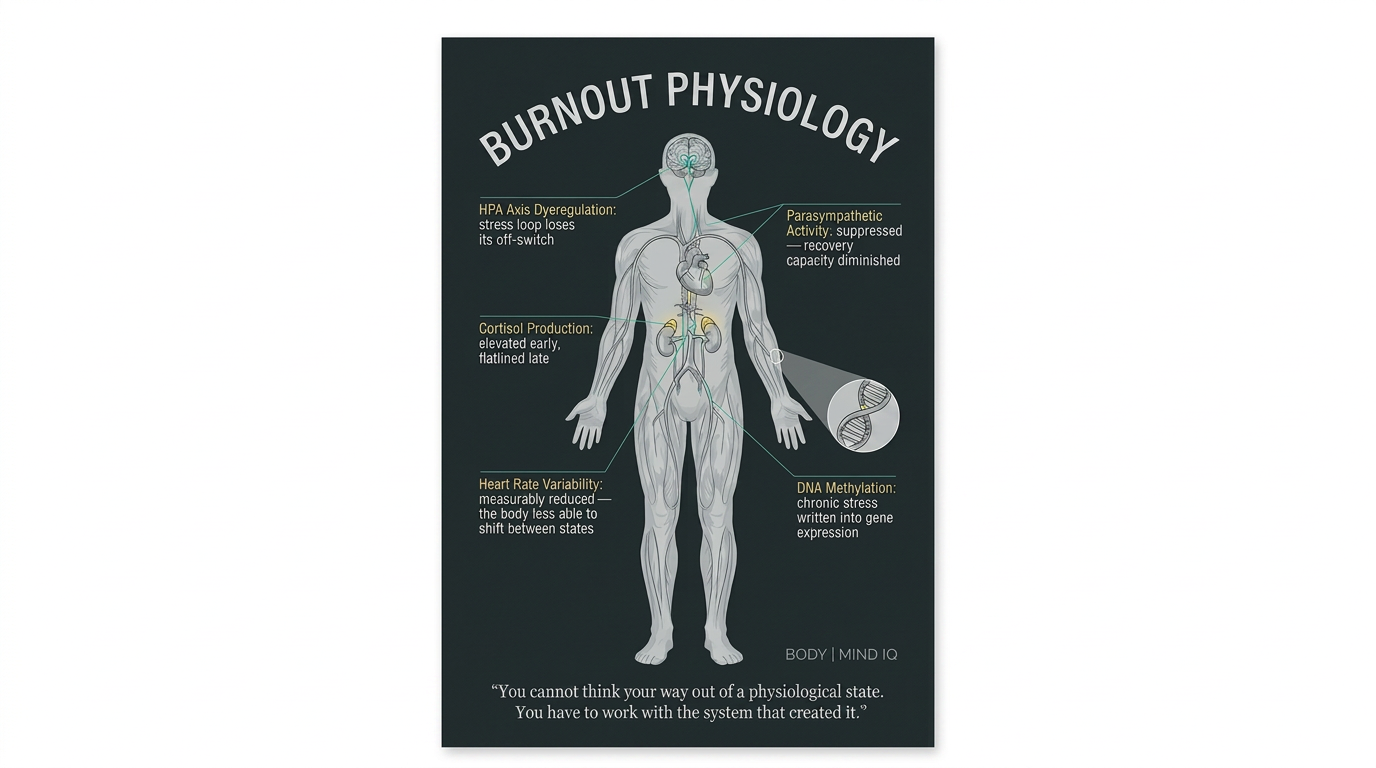
The Physiology of Burnout
Research also confirms that burnout is associated with reduced parasympathetic activity and measurably lower heart rate variability (HRV), the physiological marker of nervous system flexibility and resilience. The body is literally less able to regulate itself, less able to recover, less able to shift between states of activation and rest.
There is also emerging epigenetic evidence: studies have found changes in DNA methylation, actual modifications to how stress-related genes are expressed, in people with clinical burnout. The body has, at a molecular level, written the experience of chronic stress into its biology.
This is why telling someone who is burned out to take a holiday, practice self-care, or try harder to set boundaries often does not work. You cannot think your way out of a physiological state. You have to work with the system that created it.
What We Do at BODYMIND IQ and Why It Works
I built BODYMIND IQ because I saw, repeatedly, what conventional approaches to burnout and leadership development miss. They address the symptoms. They work from the neck up. They offer strategies and frameworks and coping tools, all of which have value, but they do not reach the place where burnout actually lives.
Burnout lives in the body. In the patterns of activation that have become the nervous system's new normal. In the stories and identities that people have built around their performance, the belief that their value is contingent on their output, that being needed is the same as being well, that the only safe direction is forward. These are not just thoughts. They are somatic patterns, held in posture, in breath, in the chronic tension and bracing that the body carries as a map of everything it has been asked to hold.
Our work with senior leadership teams and corporate clients operates at this level.
And it does so through three integrated approaches.
1. Somatic Breathwork for Physiological Offload
Somatic breathwork is not relaxation breathing. It is a deliberate, evidence based practice that works directly with the autonomic nervous system to help the body complete stress cycles that have been left unfinished, often for months or years. The science is clear: a 2023 meta-analysis in Nature's Scientific Reports, reviewing 12 randomised controlled trials across 785 participants, found that breathwork produced clinically significant reductions in stress (effect size g = -0.35), anxiety (g = -0.32), and depressive symptoms (g = -0.40). A 2022 randomised trial showed that just 20 minutes of resonance breathing daily over four weeks produced significant improvements in Heart Rate Variability (HRV) the very marker that burnout depletes.
In our sessions, we use structured breathwork protocols to help leaders access and release the physiological load that has accumulated beneath the surface. This is not about processing trauma in a clinical sense, though for some people it moves in that direction. It is about giving the nervous system what it has not been allowed: the experience of completing a stress cycle, returning to baseline, and feeling what genuine regulation actually feels like.
2. Working with Stories and Identity Patterns
The patterns that keep people in burnout are rarely just about workload. They are about identity., about what it means to stop, about the story that says: if I am not performing, I am not enough.
These patterns are somatic as much as cognitive. They live in the holding of the breath, in the inability to rest even when rest is available, in the compulsive checking of a phone, in the guilt that arises when someone tries to switch off. Our work helps leaders become aware of these patterns, not from the outside, with a framework or a model, but from the inside, through the body's own signals.
When someone can feel the pattern, the bracing, the holding, the drive that has become disconnected from genuine desire, they can begin to work with it. Not by suppressing it, but by understanding what it has been protecting and building a different relationship with it.
3. Building Capacity, Not Just Coping
This is the distinction I care most about. Most burnout interventions are reactive: they help people manage once they are already depleted. Our work is about building genuine nervous system capacity, so that leaders can hold more and sustain more without tipping into depletion.
Capacity is not about enduring more. It is about having more physiological resource to draw on. A regulated nervous system, one with high HRV, strong vagal tone, the ability to shift fluidly between activation and recovery, is simply more capable. More capable of clear decision making, of emotional regulation, of genuine connection with the people it leads, of creative thinking and of strategic vision.
This is what we build. Not to push harder, but he ability to lead from fullness rather than from depletion.
“The goal is not to manage burnout better. It is to build the capacity so that you never have to.
Leadership that flows from a regulated, resourced nervous system is a different quality of leadership entirely.”
A Final Word
If you are reading this and something in it is resonating, if you recognise the exhaustion, the detachment, the quiet sense that you are not quite yourself anymore, I want you to know something.
This isn’t a weakness, you’re a human being who has been asking a great deal of a nervous system that was never designed for the pace, the pressure, and the always on demands of modern leadership.
And there is a way through, not by pushing harder or by a holiday that only temporarily interrupts the pattern. But by doing real work with the system that is struggling, the body, the breath, the nervous system, the stories you carry.
That is what we are here for.
References
Freudenberger, H.J. (1974). Staff burn-out. Journal of Social Issues, 30(1), 159-165. Original clinical description of burnout.
Maslach, C. & Jackson, S.E. (1981). The measurement of experienced burnout. Journal of Occupational Behaviour, 2(2), 99-113. First validated burnout inventory (MBI).
Maslach, C. & Leiter, M.P. (2016). Understanding the burnout experience: recent research and its implications for psychiatry. World Psychiatry, 15(2), 103-111.
World Health Organization (2019/2022). Burnout an 'occupational phenomenon': International Classification of Diseases (ICD-11). who.int
Gallup (2025). State of the Global Workplace Report. Manager engagement decline; 70% team engagement variance.
Deloitte (2022). Workplace Burnout Survey. 77% burnout prevalence; 70% C-suite considered leaving.
McKinsey Health Institute. Employees in toxic environments are 8x more likely to burn out.
Modern Health / HR Brew (2025). State of Workplace Burnout 2025. 82% at risk; 66% all-time high.
Sonnenschein, M. et al. (2007). Cortisol in burnout and vital exhaustion: an overview. PubMed.
Lennartsson, A.K. et al. (2015). Burnout Is Associated with Reduced Parasympathetic Activity and Reduced HPA Axis Responsiveness. PMC4628754.
Fincham, G.W. et al. (2023). Effect of breathwork on stress and mental health: A meta-analysis of randomised-controlled trials. Scientific Reports (Nature). s41598-022-27247-y
Magnon, V. et al. (2021). Benefits from one session of deep and slow breathing on vagal tone and anxiety. Scientific Reports.
Epigenetic evidence: Zannas, A.S. et al. Role of NR3C1 and SLC6A4 methylation in the HPA axis regulation in burnout. PubMed 34509065.